What Mental Health Coaching Is
A mental health coach is a working professional partner focused on the present and future, on goals, accountability, behavior change, and the practical work of living well with a mental health or substance use condition.
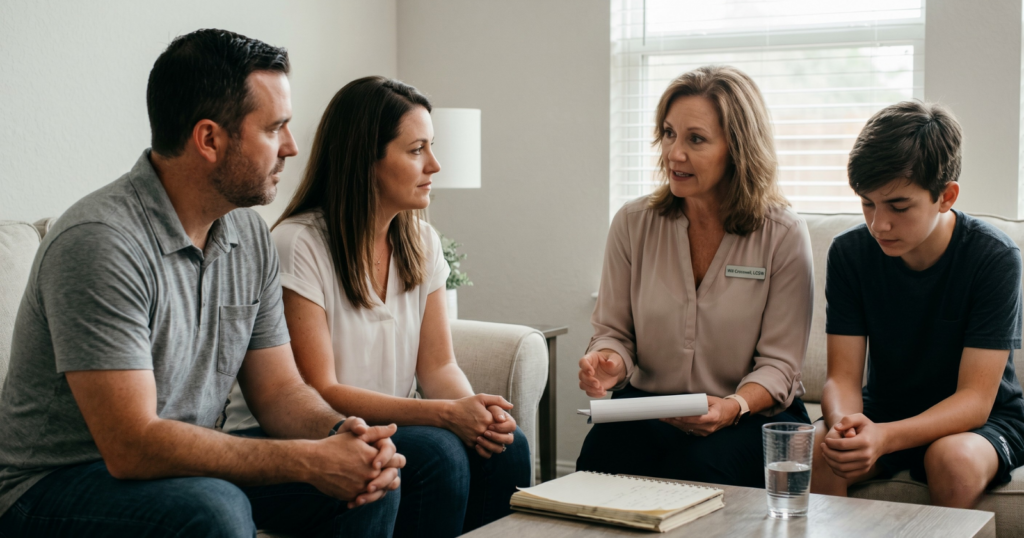
The structure of coaching looks something like this. Regular sessions, often weekly, sometimes more frequently in higher-need periods. Each session focuses on specific goals: how the past week went, what got in the way, what to work on this week, what supports need to be in place. Between sessions, the coach is often available for shorter check-ins, particularly during difficult moments. Coaching is action-oriented, behaviorally focused, and structured around the question “what do we do next.”
What a mental health coach typically does:
- Helps the person set realistic, sequenced goals for the area they’re working on
- Provides accountability and structure between therapy or psychiatric appointments
- Supports skill-building (often around boundaries, communication, time management, sleep, daily routines)
- Helps the person recognize and respond to early warning signs of decompensation
- Works with family members on family-system patterns when relevant
- Supports relapse prevention in the case of recovery coaching specifically
- Bridges the gap between treatment intensity and independent functioning
The clinical literature increasingly recognizes coaching as a meaningful tier of care, particularly in the post-treatment recovery space and in conditions where ongoing structure and accountability are the difference between holding ground and losing it. The National Institute of Mental Health describes the continuum of mental health care as including supportive interventions like coaching alongside more clinically intensive options.
For Texas families specifically, clinician-led mental health coaching in Texas is the right entry point when the question is “we need ongoing structured support” rather than “we need diagnostic treatment.”
What Mental Health Coaching Is Not
Defining what a service doesn’t do is part of doing it ethically. This section matters as much as the previous one.
Coaching is not therapy. Therapy, sometimes called counseling or psychotherapy, is a clinical relationship in which a licensed mental health professional (LCSW, LMFT, LMHC, LPC, PsyD, or PhD) works with a client to diagnose and treat mental health conditions using evidence-based clinical methods. Therapy can address trauma, complicated grief, deeply held patterns of thinking and feeling, psychiatric symptoms, and the wide range of clinical concerns that fall under the diagnostic categories of the DSM. Coaching does not do this work. A coach who tries to do this work without a clinical license is operating outside the boundaries of the profession.
Coaching is not psychiatry. Psychiatry involves the medical evaluation and treatment of mental health conditions, including the prescription and management of psychiatric medication. Only physicians (MD or DO), nurse practitioners with prescriptive authority, or physician assistants under supervision can prescribe and manage these medications. A coach does not diagnose, does not prescribe, and does not adjust medication. If you are working with a psychiatrist or psychiatric nurse practitioner, the coach works alongside that care; the coach does not replace it.
Coaching is not crisis intervention. If your loved one is in acute crisis, including active suicidal ideation, active homicidal threat, severe self-harm, active psychosis with safety implications, or any other acute situation requiring immediate clinical or emergency response, a coach is not the appropriate first call. The appropriate first calls are 911, 988, or the local crisis line, followed by therapy or psychiatric care.
Coaching is not pastoral counseling, spiritual direction, or life coaching in the general sense. These are separate services with separate purposes. A pastor or spiritual director may provide meaningful support in their lane. A “life coach” who has no clinical training is providing yet another distinct service. Mental health coaching specifically is its own thing, and conflating it with these adjacent services obscures what it actually is.
The honest framing: coaching is a narrow service. Its narrowness is what makes it useful within its scope. When families are clear about what they need, the clarity itself sometimes solves half the problem.
When Coaching Is the Right Choice
Coaching fits the following situations particularly well:
After residential treatment, during the vulnerable first 6-12 months home. This is one of the strongest use cases. A person who has completed inpatient or residential treatment is returning to the home environment, the relationships, and the routines that existed before treatment. The literature on relapse and on post-treatment psychiatric stability is consistent: the first 6-12 months back home is the highest-risk window. Coaching provides the structure that the residential program provided, in a less intensive form, during this transition. The Substance Abuse and Mental Health Services Administration recognizes recovery coaching and peer support as evidence-based recovery support services.
For someone in ongoing therapy who needs between-session support. Therapy typically happens weekly or every other week. For many people with significant mental health conditions, that is not enough structure on its own. Coaching can fill the gap, with the coach and therapist working as a coordinated team (with the client’s consent for the communication between them).
For families parallel to a loved one’s treatment or recovery. This use case is often missed. The family that has been navigating a loved one’s addiction or mental illness usually needs its own structured support. Family recovery coaching is a distinct service that we’ll get to in more detail below.
For someone with a chronic condition who is stable but needs structure. Bipolar disorder, severe ADHD, PTSD in recovery, persistent depressive disorder. These conditions don’t go away when a person is stable; they require ongoing maintenance. Coaching can provide the maintenance structure during stable periods, with escalation to therapy or psychiatry if symptoms return.
For early-recovery individuals navigating life rebuilding. The practical work of recovery often involves rebuilding work, finances, relationships, housing, and identity. Coaching focuses directly on this practical rebuilding work in ways that therapy, with its more interior focus, often does not.
When Coaching Is Not the Right Choice
This section builds trust by being specific:
Active suicidal ideation. If your loved one is having thoughts of suicide, the appropriate path is a therapist trained in suicide prevention, a psychiatrist, or crisis services. Coaching does not have the clinical scope for active suicidality.
Untreated active psychosis. If your loved one is experiencing delusions, hallucinations, or significant breaks with consensus reality, the appropriate first step is psychiatric evaluation. Coaching may have a role later, after psychiatric stabilization, but not as the first response.
Active addiction crisis. If your loved one is in active substance use that has reached crisis level (escalating use, overdose risk, loss of major life anchors, severe withdrawal risk), coaching is not the right response. The right response is intervention, treatment, or both. Coaching often comes after these other interventions, not before.
Acute trauma response. If your loved one is in the acute phase of a trauma response, particularly with severe dissociation, flashbacks, or significant functional impairment, the right care is trauma-focused therapy with a clinician trained in trauma treatment (EMDR, CPT, prolonged exposure, or similar evidence-based approaches). Coaching may support the long arc of trauma recovery, but it does not replace specialized trauma care.
Active eating disorder requiring medical attention. Eating disorders, particularly anorexia nervosa and bulimia nervosa, often carry significant medical risk that requires specialized treatment teams including a medical provider, a dietitian with eating disorder training, a therapist with eating disorder expertise, and sometimes psychiatry. Coaching is not a substitute for this specialized care.
Each of the above situations has appropriate clinical responses that are not coaching. We refuse cases that fall into these categories not because coaching couldn’t theoretically help, but because the case requires a higher tier of care first, and coaching applied at the wrong tier delays the care the person actually needs.
The Texas-Specific Landscape
Texas has its own particular landscape for mental health and recovery support, and several factors shape why coaching matters in this state specifically.
The provider shortage. Texas has significant Mental Health Professional Shortage Areas, including substantial parts of rural Texas and even within metropolitan markets where wait times for licensed providers can run months. Coaching can fill the practical gap between “I know I need support” and “I have a therapist with availability” for cases where coaching is clinically appropriate.
The geographic scale. Texas is large. Even within metro markets like Houston, Dallas-Fort Worth, San Antonio, and Austin, getting to weekly therapy can be a major logistical undertaking. Coaching is often delivered via video, which removes geographic barriers and serves rural Texas in ways that office-based therapy alone cannot.
The licensing context. Coaching is unregulated at the federal level. There is no state license required to call oneself a coach in Texas or in any other state. This means that the qualifications of the coach matter enormously. The difference between a coach with no clinical training and a coach who is a licensed clinician (LCSW, LCDC, LMFT, LPC) operating in the coaching modality is substantial. Both can call themselves “coaches” legally. Only one of them brings the clinical training to recognize when a coaching case has moved into clinical territory that requires escalation.
This is one reason we are explicit about the clinical credentials behind our coaching services. The coaching we provide is grounded in the same clinical training that informs our intervention work. When a case requires escalation to therapy, psychiatry, or full intervention, the clinical eye recognizes it.
Family Recovery Coaching as a Separate Thing
One of the most common patterns we see in Texas families is the focus on the identified patient at the expense of the family system. The adult son with the substance use disorder needs help. The daughter with bipolar disorder needs help. The husband with PTSD needs help. Of course they do.
But the family system that has organized around the identified patient’s condition also needs help, and often the family doesn’t realize it.
Family recovery coaching addresses this directly. The work focuses on:
Boundaries. Not in the pop-psychology sense of cutting people off, but in the clinical sense of identifying what the family is responsible for, what they aren’t, and what patterns of behavior are sustaining the situation they want to change.
Communication patterns. Many family systems with a member in recovery or mental illness have developed communication patterns that worked for managing crisis but don’t work for sustaining recovery. Coaching helps the family build new patterns.
The codependency and “managing” traps. Both terms get overused, but they describe real patterns. The spouse whose entire identity is organized around managing their partner’s bipolar disorder. The parents whose retirement plans have been on hold for fifteen years because of an adult child’s addiction. These patterns are usually not pathological; they are learned responses to a long crisis. Coaching helps the family recognize them and choose differently.
The Crosswell Method’s ongoing support phase. Our intervention work culminates in the Sustained Family Support phase, which is family recovery coaching by another name. Many families enter this phase after a successful intervention. Some families come to it without an intervention having happened, because the family work itself is what they need.
For Texas families with extended family structures, multiple generations, and the cultural patterns that produce highly involved family systems, this work is particularly relevant. Discussion of family system resistance to intervention explores this in more depth.
How Coaching Connects to Intervention Work
The full arc of family-supported recovery typically looks like this:
Crisis. Something in the family system has reached a point where the existing way of managing is no longer working. The loved one’s condition is deteriorating, or the family’s capacity is exhausting, or both.
Intervention. A structured, clinician-led process helps the loved one accept treatment. This is appropriate for cases involving treatment refusal where the situation has reached an inflection point. For Texas families specifically, professional mental health intervention in Austin and across the state follows this model. In other cases, a full mental health intervention addresses the broader psychiatric refusal pattern.
Treatment. Residential or intensive outpatient programs provide the clinical intensity needed to stabilize the underlying condition.
Coaching. After treatment, coaching provides the structured support that the residential program no longer can. This is where coaching does its most concentrated work.
Integration. Over time, the person and family integrate the changes into the regular rhythm of their lives. Coaching tapers, therapy continues at appropriate intensity, family relationships stabilize.
Not every case requires every step. Some cases enter at the coaching tier without needing intervention. Other cases need intervention but are not ready for coaching until significantly later. The clinical question we ask families is always “where on this arc are you right now, and what’s the next clinically appropriate step?”
The clinical case management piece sits underneath all of these phases. Clinical case management is the coordination work that keeps a complex case organized: scheduling, communication between providers, treatment placement decisions, family logistics. For higher-acuity cases, especially ones involving multiple clinical providers, case management is often the difference between a recovery that holds and a recovery that fragments.
Frequently Asked Questions
Is mental health coaching covered by insurance?
Mental health coaching is generally not covered by health insurance, because coaching is not a licensed clinical service and falls outside the categories that insurance reimburses. There are exceptions in specific employer wellness programs or specific health-and-wellness benefits. The general answer for families to plan around is: coaching is typically a private-pay engagement. We discuss costs transparently in the initial consultation.
Can you do coaching by video for someone in rural Texas?
Yes. Most coaching engagements are conducted by video, which makes them accessible to families anywhere in Texas regardless of distance from major metros. Some in-person work is appropriate for certain phases of family coaching, but the regular ongoing sessions are typically video-based.
What’s the difference between a recovery coach and a sponsor?
A sponsor is a peer in a 12-step recovery program who has personal experience with recovery and supports a newer member through working the program steps. The relationship is voluntary, non-professional, and based on shared lived experience. A recovery coach is a professional working relationship, typically paid, with someone who has specific training in recovery coaching (and, in our case, clinical training as well). The two are not in competition. Many people in recovery have both. They serve different functions.
Do I need to be in active treatment to work with a coach?
No. Some coaching relationships happen alongside active therapy or psychiatry. Some happen after treatment has concluded. Some happen for family members of someone in treatment. The right structure depends on the case.
Can my whole family work with a coach together?
Yes, in the family recovery coaching model. Family sessions and individual sessions can both be part of the engagement, depending on what the family needs.
How is family recovery coaching different from family therapy?
Family therapy is a licensed clinical service provided by a Licensed Marriage and Family Therapist (LMFT) or other licensed clinician trained in family systems work. It addresses clinical concerns within the family unit, often diagnosable patterns of dysfunction. Family recovery coaching is a coaching service focused on the practical, present-and-future work of supporting recovery within the family system. It does not diagnose family-level pathology. It builds skills and structure for the family to function more effectively around recovery. The two are complementary, not substitutes.
Conclusion
Mental health coaching is one of the most useful services in the recovery and behavioral health landscape when it is applied to the right cases. It is also one of the most misunderstood services, because the word “coaching” gets used loosely and because the boundary between coaching and adjacent services (therapy, sponsorship, case management, intervention) is often unclear in family-facing language.
For Texas families trying to figure out what kind of help fits their situation, the most useful first step is a clarifying conversation with a clinician who can listen to the situation, identify which tier of care is clinically appropriate, and make a clear recommendation, even if the recommendation is that coaching is not the right starting point. We do not provide coaching services to cases that need a different tier of care first. The clarity itself is part of the value.
About the Author
Will Crosswell is a Licensed Clinical Social Worker (LCSW), Licensed Chemical Dependency Counselor (LCDC), Love First Certified Clinical Interventionist, and EMDR-trained clinician with more than ten years of experience helping families navigate addiction and mental health crises. Crosswell Interventions provides clinician-led coaching, intervention, and family recovery services to Texas families and to families across the country. Crosswell Interventions is independent and does not accept referral fees from treatment facilities.