Families often assume the hardest moment of an intervention is the conversation itself, the part where you finally say the thing out loud and ask your loved one to accept help. In practice, the hardest moment is frequently the one right after the yes. A person agrees to treatment, and then there is a gap: hours, sometimes a day, between the decision and actually arriving at a program. In that gap, resolve can fade, fear can take over, and plans can quietly fall apart. This article explains how sober transport and treatment coordination close that gap, especially across a region as large as Dallas-Fort Worth.
The gap families do not anticipate
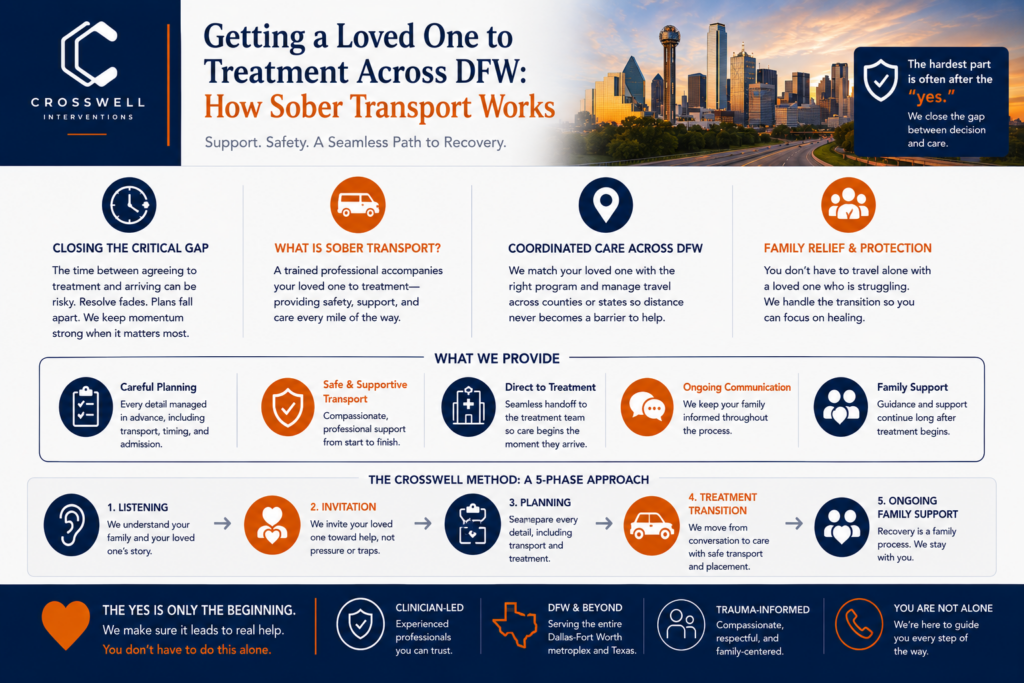
Deciding to get help is a fragile, hard-won moment. Addiction does not pause to respect it. Between agreeing to treatment and walking through a facility’s doors, a person may have second thoughts, experience withdrawal, encounter someone or something that pulls them back, or simply lose their nerve. Many well-intentioned plans collapse in exactly this window, not because the family did anything wrong, but because no one had prepared for the space between yes and arrival.
This is the space sober transport is built for. It is not about force. It is about making sure that a person who has agreed to get help actually gets there, with support, safety, and dignity along the way.
Families rarely see this gap coming, because so much energy goes into preparing for the conversation itself. They rehearse what to say, brace for the reaction, and imagine the relief of a yes. Almost no one plans for the drive afterward, the wait for a bed to open, or the long quiet hours in which a frightened person second-guesses the biggest decision of their life. Naming that window in advance, and having a plan for it, is often what separates an intervention that holds from one that unravels.
How sober transport works
Sober transport means a trained professional accompanies your loved one from where they are to where they are going, whether that is a treatment facility across town or a program in another part of the state or country. The role is part logistics and part support: keeping the person safe, calm, and moving toward care, managing the practical details, and staying with them through a stretch that can be emotionally difficult. It is a job that calls for both steadiness and warmth, since the person being transported is often frightened, ashamed, or physically unwell, and how they are treated in those hours can shape how they walk into treatment.
For families, the relief is significant. Rather than a parent or spouse trying to drive a frightened, ambivalent, or physically unwell loved one to treatment alone, often while managing their own exhaustion and emotion, a professional handles the transition. That protects both the person entering treatment and the relationships around them.
Coordinating care across the metroplex and beyond
Dallas-Fort Worth is not one place. It is a sprawl of counties, and the family, the intervention, and the right treatment program are often in three different locations. A family might live in one county, the program that best fits their loved one might be in another, or out of state entirely, and the logistics of getting from here to there can feel overwhelming on top of everything else.
Coordination is what makes that manageable. It means matching the person to a program that actually fits their needs rather than whatever is closest, arranging travel, handling admission timing, and making sure nothing falls through a crack at a moment when cracks are dangerous. Because the metroplex is so large, this cross-county and sometimes cross-state coordination is a routine part of getting DFW families the help they need. It is worth saying plainly that the closest program is not always the right one. The best fit depends on the person’s substance, their history, any co-occurring mental health needs, and practical factors like insurance and timing. A good placement matches the person to the care they actually need, even when that means traveling farther, and sober transport is what makes that reach possible without adding strain to a family that is already stretched thin. For the broader regional picture of the crisis this work responds to, see our overview of the fentanyl landscape across Dallas-Fort Worth.
How this fits the Crosswell Method
Sober transport and coordination are the living expression of one phase of our five-phase approach, the Crosswell Method, specifically the transition into treatment. The full sequence is designed so that no single step is left to chance:
- Listening. Understanding the family system and the person’s story before any plan is made.
- Invitation. Bringing the person toward help rather than cornering them.
- Planning. Preparing every practical and clinical detail in advance, including exactly how the transition to treatment will happen.
- Treatment transition. Moving from the conversation to actual care, including safe transport and placement. This is the phase where sober transport lives, and it is where many interventions succeed or fail.
- Ongoing family support. Continuing the work after treatment begins, because recovery is a family process.
The reason the transition phase gets its own careful attention is simple: it is the point where the most interventions fall apart. A plan that stops at the yes is only half a plan. The hours after agreement are not an afterthought to manage casually. They are a distinct stage that deserves as much preparation as the conversation itself, and treating them that way is one of the quiet reasons some interventions succeed where others come so close and then slip away.
Why not just drive them yourself
Many families try, and sometimes it works. But there are good reasons to consider professional transport. A loved one may be physically unwell, emotionally volatile, or actively reconsidering. Withdrawal can begin during travel. A familiar family dynamic, the very one that has been strained for months or years, can flare at the worst possible moment. A neutral, trained professional changes that equation, and lets family members be family rather than enforcers during a delicate few hours. It is worth knowing what good transport looks like: a professional who treats the person with respect rather than as cargo, who can respond calmly to fear or early withdrawal, who keeps the family informed, and who hands off to the treatment program cleanly so nothing is dropped at admission. Done well, the transition is almost invisible, and that is the point. The person arrives, the care begins, and the family can finally breathe.
How Crosswell Interventions helps DFW families
We provide clinician-led intervention and recovery support across Texas, including throughout the Dallas-Fort Worth metroplex, and coordination is a core part of what we do. We help match a loved one to the right program, arrange sober transport across county or state lines, and manage the transition so the distance between deciding to help and actually arriving at treatment does not become the place where everything stalls. Our approach is trauma-informed and family-centered from the first call through the handoff to care and beyond. To understand what comes next once treatment begins, our guide on what happens after an intervention walks through the recovery road ahead.
Frequently Asked Questions
What is sober transport, and who needs it? Sober transport is when a trained professional accompanies a person from where they are to a treatment program, keeping them safe and supported along the way. It helps most when a loved one is ambivalent, physically unwell, at risk of changing their mind, or when the program is far away and the family cannot safely manage the trip alone.
How do you get someone to treatment if they change their mind on the way? This is exactly the risk sober transport is designed to reduce. A trained professional is prepared to manage second thoughts, fear, and early withdrawal with support rather than force, keeping the person moving toward care during the fragile window when resolve is easy to lose.
Can you transport a loved one to an out-of-state facility? Yes. Because the right program is not always local, coordination often involves travel across state lines. This is a routine part of treatment placement, and it is planned in advance so the logistics do not become a barrier at the last moment.
Is sober transport forceful? No. It is built on the person’s agreement to get help, and it is about support and safety, not coercion. The aim is to honor the decision your loved one has made and help them follow through on it, at the exact moment when following through is hardest.
A final thought
The yes is precious, and it is fragile. What a family does in the hours after it can matter as much as everything that came before. Across a region as large as Dallas-Fort Worth, closing the gap between deciding to get help and actually arriving at care is not a minor detail. It is often the difference between an intervention that works and one that slips away.
About the Author
Will Crosswell is a Licensed Clinical Social Worker (LCSW), Licensed Chemical Dependency Counselor (LCDC), and EMDR-trained clinician with more than ten years of experience helping families navigate addiction and mental health crises. His clinical training in trauma-informed care and family systems work informs the Crosswell Method’s approach to mental health intervention specifically. Crosswell Interventions is independent and does not accept referral fees from treatment facilities.