Texas has changed its fentanyl laws significantly in recent years, and the result can be confusing, especially for a family in the middle of a crisis. Some of the changes are about punishment, some are about saving lives, and some remain unsettled and hotly debated. This guide explains the major pieces in plain language, neutrally, so you can understand the landscape without needing a law degree. It is general information, not legal advice, and laws change; for a specific situation, or to confirm the current rule on any point below, consult a Texas attorney or a primary legal source.
House Bill 6 and the shift to "poisoning"
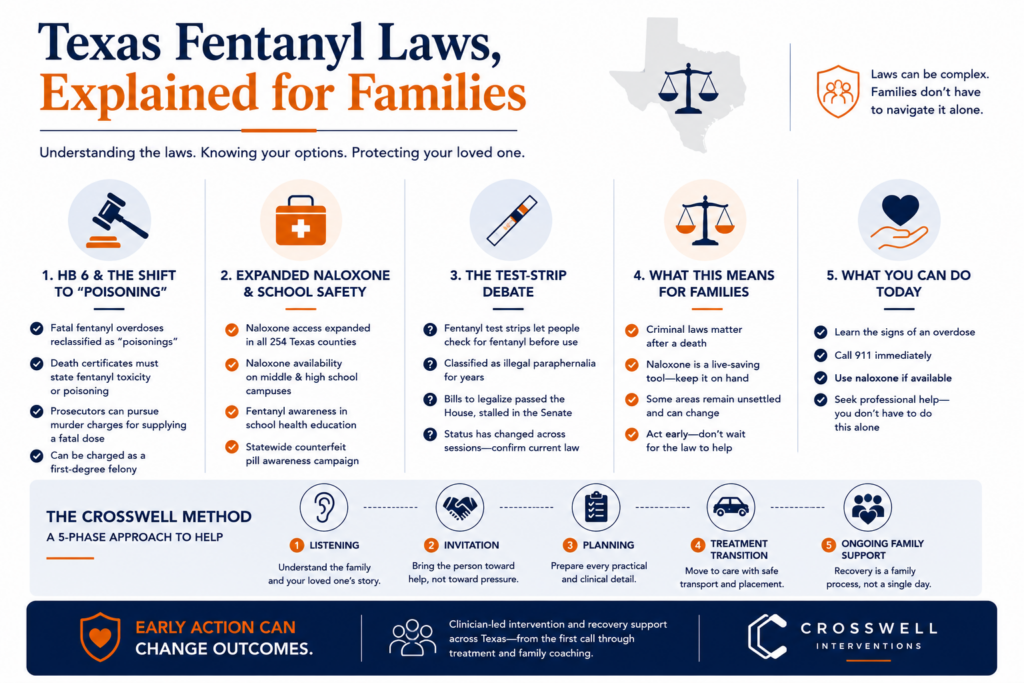
The centerpiece of Texas’s recent approach is House Bill 6, passed in 2023. It did several things. It reframed fatal fentanyl overdoses as “poisonings” rather than ordinary overdoses, a change in language meant to reflect that many victims never knew they were taking fentanyl. It required death certificates in these cases to state fentanyl toxicity or poisoning as the cause, which improves the state’s ability to track the crisis. And, most consequentially, it opened the door for prosecutors to pursue murder charges against a person who supplies a substance containing fentanyl that results in a death.
That last provision is the one families hear about most. In practice, it means that supplying a fatal dose, even a single counterfeit pill, can potentially be charged as a first-degree felony. Some counties, including Tarrant County around Fort Worth, have been especially willing to pursue these charges, which we cover in our piece on fentanyl and murder charges in Fort Worth.
Expanded naloxone and school safety measures
Alongside the tougher penalties, Texas expanded access to naloxone, the medication that reverses opioid overdoses. State efforts have pushed naloxone distribution across all 254 counties, and related measures have focused on schools and young people, including requirements aimed at keeping naloxone available on middle and high school campuses and adding fentanyl awareness to school health education. The state also runs a public awareness campaign centered on the danger of counterfeit pills, and has designated a fentanyl awareness month.
These measures reflect the other half of the state’s approach: not only punishing suppliers after a death, but trying to prevent deaths in the first place. For most families, the naloxone provisions are the more immediately useful, because they make a life-saving tool easier to find. The distinction is worth holding onto: some of these laws are designed to punish after the worst has happened, while others are designed to prevent it. For a family with a loved one still at risk, the preventive tools are the ones to reach for first, and they are more available now than they were even a few years ago.
The test-strip debate
One area remains genuinely unsettled and worth understanding, because it comes up constantly: fentanyl test strips. These are inexpensive strips that let a person check whether a drug contains fentanyl before using it. Supporters, including many public health experts and, at times, the governor, describe them as a simple tool that can prevent poisonings, particularly for people who never intended to take an opioid at all.
For years, Texas classified these strips as illegal drug paraphernalia. Bills to legalize them repeatedly passed the Texas House by wide, bipartisan margins, only to stall in the Senate, where some leaders argued that legalizing the strips could be seen as condoning drug use. Because the legal status has been contested and has shifted over successive legislative sessions, families should not assume they know the current rule. This is the one area of Texas fentanyl law where you should confirm the present status directly before relying on it.
The broader debate here mirrors a national one between an enforcement-focused approach and a harm-reduction approach. Reasonable people disagree, and the point of this guide is not to settle that argument but to help you understand what is actually in dispute.
Texas has also been cautious about other harm-reduction measures that some states have adopted, such as syringe service programs, which have repeatedly failed to advance in the Legislature. And questions around Good Samaritan protections, the legal shields meant to encourage people to call 911 during an overdose without fear of arrest, remain part of the same larger conversation. For families, the throughline is that Texas policy leans enforcement-forward, that the life-saving tools are expanding but unevenly, and that the ground is still shifting.
What this means for a family in crisis
Legal detail can feel distant when you are simply frightened for someone you love. Here is the practical translation.
First, the criminal provisions of HB 6 mostly matter after a death, so they offer little to a family whose loved one is still alive and still using. Second, the naloxone expansion is directly useful right now: it means the tool that can reverse an overdose is easier to obtain, and keeping it on hand is one of the most concrete protective steps available. Third, the unsettled areas, like test strips, are a reminder that Texas policy is still evolving, and that the safest posture for a family is not to wait for the law to protect a loved one, but to act on their own.
There is also a practical point every family should know, regardless of the legal fine print. If you witness an overdose, call 911 immediately and administer naloxone if you have it. Saving a life comes first. While the details of legal protections can be complex and are debated, no family should let uncertainty about the law delay a call that could keep someone alive. Learning the signs of an overdose, and keeping naloxone accessible, is worth doing in every household where a loved one may be at risk.
The legal system, in other words, is not built to reach your loved one in time. It reacts to what has already happened. That job of reaching a person early belongs to the family, while there is still room to change the outcome. Understanding the law is useful, and being clear about its limits is even more useful, because it points a worried family back toward the actions that are actually within their control. We have written about why Texas fentanyl deaths are finally falling and what it means for families, which puts the current moment in context.
How Crosswell Interventions helps
We provide clinician-led drug and alcohol intervention services across Texas, from the first worried phone call through treatment placement and family coaching. Our focus is the thing the legal system cannot do: reaching a person while they are still here, through a trauma-informed, non-confrontational approach built around the Crosswell Method of listening, invitation, planning, treatment transition, and ongoing family support. We help families navigate treatment and recovery regardless of any legal complications in the background.
Frequently Asked Questions
Can someone be charged with murder for a fentanyl death in Texas? Yes, under House Bill 6, prosecutors can pursue murder charges against a person who supplies a substance containing fentanyl that causes a death. This can apply even to a single counterfeit pill. Whether charges are filed depends on the facts and the county, and outcomes are decided in court.
Are fentanyl test strips legal in Texas? This has been contested and subject to change. For years the strips were classified as illegal paraphernalia, and legalization bills passed the House repeatedly but stalled in the Senate. Because the status has shifted across legislative sessions, confirm the current law directly before relying on it.
Where can I get free naloxone in Texas? Texas has expanded naloxone distribution statewide, including through pharmacies, community organizations, and public health programs, and the state maintains a naloxone locator resource. It is safe to carry and can reverse an opioid overdose.
Does the law require naloxone in Texas schools? Texas has adopted measures aimed at keeping naloxone available on middle and high school campuses and at adding fentanyl awareness to school health education. Check with your local district for how these measures are implemented in your area.
A final thought
Texas has moved on fentanyl from two directions at once: tougher penalties for suppliers and wider access to the tools that save lives, with some questions still unresolved. Understanding the law can bring a sense of order to a frightening situation. But the most important takeaway for a family is also the simplest. The law will not reach your loved one in time. You can. Acting early, while there is still room to help, remains the most powerful thing within a family’s control. Laws will keep changing, and it is worth staying informed as they do. But no statute, in whichever direction it moves, replaces a family that decides to step in while their loved one is still here to help.
This is a sensitive topic. If you or someone you love is struggling, support is available, and you do not have to navigate it alone.
About the Author
Will Crosswell is a Licensed Clinical Social Worker (LCSW), Licensed Chemical Dependency Counselor (LCDC), and EMDR-trained clinician with more than ten years of experience helping families navigate addiction and mental health crises. His clinical training in trauma-informed care and family systems work informs the Crosswell Method’s approach to mental health intervention specifically. Crosswell Interventions is independent and does not accept referral fees from treatment facilities.