It is usually late when the search happens. Somebody has finally said out loud that this cannot keep going, and now a mother or a spouse or a grown daughter is sitting in the dark in Katy or Pearland or the Heights with a laptop open, typing “interventionist Houston” into Google.
What comes back looks reassuring at first. Warm photography, calm typefaces, promises about getting your loved one the help they need. Then, somewhere around the eighth website, a different feeling sets in. They all say roughly the same thing. There is no obvious way to tell them apart. And you are about to hand one of these people the most fragile situation your family has ever been in.
If that is where you are tonight, here is something worth knowing before you make any calls.
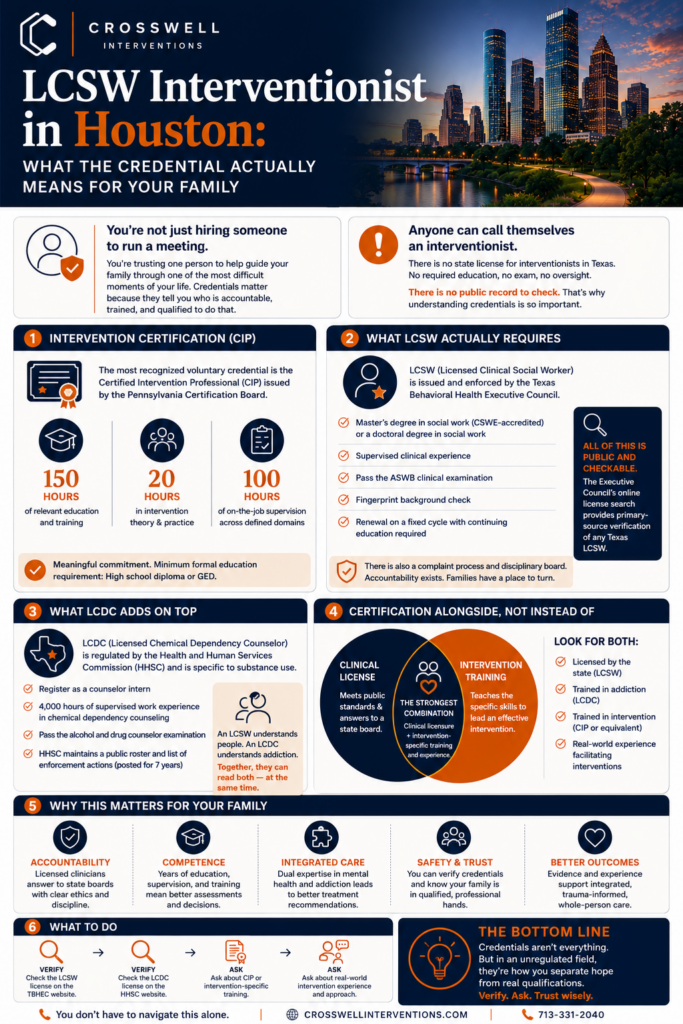
Anyone can call themselves an interventionist
This is not a criticism of the field. It is a description of how the field is regulated, or more precisely, how it is not.
There is no state license for interventionists in Texas. Unlike a nurse, a therapist, or a pharmacist, a person who wants to work as an interventionist does not have to apply to a board, meet an education standard, pass an exam, or submit to ongoing oversight. Industry organizations describe intervention as a relatively new and largely unregulated field, and note that efforts to establish licensing have not produced a state-issued credential.
The field has worked to fill that gap on its own. The most widely recognized voluntary credential is the Certified Intervention Professional, or CIP, issued by the Pennsylvania Certification Board. Earning it requires 150 hours of relevant education and training, including 20 hours in intervention theory and practice, plus 100 hours of on-the-job supervision across defined intervention domains. That is a real commitment and a meaningful signal. It is also worth knowing that the CIP’s minimum formal education requirement is a high school diploma or GED.
Many capable interventionists hold the CIP and nothing else. The point is not that certification is worthless. The point is that certification is voluntary, and a family looking at a website has no way to tell whether the person behind it holds any credential at all.
Licensure is different. Licensure leaves a public record.
What LCSW actually requires
LCSW stands for Licensed Clinical Social Worker. In Texas the credential is issued and enforced by the Texas Behavioral Health Executive Council, the state agency that also regulates psychologists, professional counselors, and marriage and family therapists.
To hold it, a clinician has to:
- Earn a master’s degree in social work from a program accredited by the Council on Social Work Education, or a doctoral degree in social work from an accredited university
- Complete a period of supervised clinical experience
- Pass the Association of Social Work Boards clinical examination
- Submit fingerprints for a criminal history check
- Renew on a fixed cycle, with continuing education required to do so
None of that is optional and none of it can be self-declared. More importantly for your purposes, all of it is checkable. The Executive Council maintains a public license search, and the agency states that results from that online system constitute primary-source verification. You can look up any Texas social work licensee by name or license number and see status, first licensure date, expiration, and public disciplinary history.
There is also a complaint process. The Executive Council handles discipline and complaints, which means a family that believes a licensed clinician behaved unethically has somewhere to take it. That option does not exist for an uncredentialed interventionist, because there is no body to complain to.
What LCDC adds on top
LCDC stands for Licensed Chemical Dependency Counselor. In Texas it is regulated separately, by the Health and Human Services Commission rather than the Executive Council, and it is specific to substance use rather than to behavioral health generally.
The pathway runs through registration as a counselor intern, 4,000 hours of supervised work experience in chemical dependency counseling, and a passing score on the alcohol and drug counselor examination. HHSC publishes a public roster of license holders and maintains a list of enforcement actions, which stays posted for seven years.
An LCSW is trained in human systems, trauma, and clinical assessment. An LCDC is trained in addiction specifically: withdrawal, levels of care, relapse, and what actually happens inside a treatment program. Holding both means a clinician can read a family and read a substance use disorder at the same time, which is what an intervention asks for.
So where does intervention certification fit?
Alongside, not instead of.
Clinical licensure tells you that a person met a public standard and answers to a state board. It does not tell you that they know how to walk into a living room in Sugar Land on a Saturday morning and hold twelve frightened people steady while someone decides the direction of their life. That is a distinct skill, learned through intervention-specific training and repetition.
The strongest combination is both. A licensed clinician who has also completed structured intervention training brings the assessment framework and ethical obligations of the first and the room-craft of the second. Will Crosswell holds both Texas licenses discussed above, is a Love First Certified Clinical Interventionist, and is EMDR-trained. You do not have to take that on faith. Both licenses can be checked in the public state systems named in this article, in about a minute each.
Why any of this changes what happens in the room
It is fair to ask whether credentials are just letters. Here is what they change in practice.
Assessment comes before the plan. A clinician is trained to evaluate what is actually going on before deciding what to do about it. Withdrawal from alcohol or benzodiazepines can carry serious medical risk, and someone who does not know that may steer a person toward the wrong level of care.
Co-occurring conditions get recognized. Mental health conditions frequently sit alongside substance use disorders. A script-based approach can get someone through the door of a facility that treats only the substance, and the family ends up back where they started months later. Clinical training is what allows an interventionist to notice the second thing.
The pacing is trauma-informed. Clinicians at Boston Medical Center’s Grayken Center for Addiction have described “rock bottom” thinking as actively troubling, because it encourages families to keep their distance and can raise the risk of overdose or death. Pressure-based tactics tend to produce compliance rather than commitment, and for someone whose substance use began as a response to harm, they can do real damage.
Ethics are written down and enforceable. Section 1.16(c) of the National Association of Social Workers Code of Ethics prohibits social workers from giving or receiving payment for a referral when the referring social worker provides no professional service. Payment-for-referral arrangements exist in the addiction treatment industry, and they are the reason some families end up in a program that suited the referrer better than it suited the patient. When your interventionist holds a license, that conflict is not merely frowned upon. It sits inside a code that licensing boards use as a frame of reference.
The Houston picture
Harris County has been living inside this for years. Texas drug poisoning deaths rose 68 percent between 2019 and 2024 according to the Department of State Health Services, and in 2023 drug poisoning was the leading cause of injury-related death for Texans between 24 and 69 years old. Harris County recorded roughly 21 drug-related deaths per 100,000 residents in 2023.
The most recent direction of travel is better. Statewide drug deaths fell close to 13 percent in 2024 from the year before, according to state health data, with naloxone availability widely credited as a factor. That is real progress and it deserves to be said plainly.
It also does not change what happens inside a single household. A statewide decline is not felt by a family in Spring Branch watching someone they love disappear. And the substance landscape has shifted underneath the headlines. Federal data compiled by USAFacts shows methamphetamine was involved in about 42 percent of Texas overdose deaths in 2024, more than any other single drug. Families who braced for an opioid conversation are increasingly facing a stimulant one, which looks and behaves differently.
What you should not wait for
There is an old idea that a person has to hit rock bottom before help can work.
It is worth naming plainly that credible voices in the field reject it. The Addiction Policy Forum, a national nonprofit, describes families as being wrongly told to wait for rock bottom, and points to research indicating that treatment works about as well for people who begin under outside pressure as for those who arrive self-motivated. Clinicians at Boston Medical Center have made a similar argument, noting that people with substance use disorders benefit from intervention and early treatment.
Waiting does not build motivation. It builds risk, and with today’s drug supply the margin for waiting has narrowed.
If you are asking whether it is too early to call anyone, it very likely is not.
How Crosswell Interventions helps Houston families
Crosswell Interventions is a clinician-led practice led by Will Crosswell, who is an LCSW and LCDC in Texas, a Love First Certified Clinical Interventionist, and EMDR-trained, with more than a decade of experience helping families navigate addiction and mental health crises.
The work follows the Crosswell Method, a five-phase framework built on the understanding that an intervention is a clinical process rather than a single dramatic event:
- Listening. Understanding the family system, the history, and what has already been tried, before anything is planned.
- Invitation. Approaching the person with dignity rather than ambush, so that saying yes is a decision rather than a surrender.
- Planning. Building the logistics, the roles, the treatment options, and the contingencies in advance.
- Treatment transition. Getting the person from the room to the appropriate level of care, including [sober transport][CONFIRM] where that is needed.
- Ongoing family support. Continuing to work with the family after the placement, because the system that surrounded the addiction has to change too.
Crosswell offers drug and alcohol intervention services in Houston and across the wider metro area, including [mental health interventions][CONFIRM] where a co-occurring condition is part of the picture. Will’s full clinical background is on the Who We Are page.
Frequently Asked Questions
Is “interventionist” a licensed profession in Texas? No. Texas does not issue a license for interventionists. Anyone can use the title. Some interventionists hold voluntary certifications such as the Certified Intervention Professional credential, and some hold separate clinical licenses such as LCSW or LCDC, but the job title itself carries no regulatory requirement.
What does LCSW mean on an interventionist’s credentials? LCSW means Licensed Clinical Social Worker. In Texas the license is issued by the Texas Behavioral Health Executive Council and requires a master’s degree in social work from a CSWE-accredited program or a doctoral degree in social work, supervised clinical experience, a passing score on the ASWB clinical examination, and a fingerprint-based criminal history check. It also places the holder under a public complaint and disciplinary process.
How can I verify a Houston interventionist’s license? Use the Texas Behavioral Health Executive Council’s online license search to check an LCSW, and the Health and Human Services Commission’s licensed chemical dependency counselor roster to check an LCDC. Both are free and public. The Executive Council states that results from its online search are considered primary-source verification. If an interventionist claims a Texas license, it should appear there within a minute or two.
Is a certified interventionist the same as a licensed one? No. Certification is voluntary and issued by private credentialing bodies such as the Pennsylvania Certification Board. Licensure is issued by a state agency and carries mandatory education requirements, examination, and an enforceable disciplinary process. Many skilled interventionists hold certification without licensure. The two are complementary rather than interchangeable, and knowing which one a professional holds tells you what oversight sits behind their work.
Do we have to wait until our loved one hits rock bottom? No, and the idea is rejected by credible voices in the field. The Addiction Policy Forum describes families as being wrongly told to wait, and points to research indicating that treatment is about as effective for people who enter under outside pressure as for those who arrive self-motivated. Clinicians at Boston Medical Center have described “rock bottom” framing as troubling, because it encourages families to stay distant and can increase the risk of overdose or death.
A closing thought for Houston families
You are not going to become an expert in behavioral health licensure tonight, and you should not have to. But the thirty seconds it takes to type a name into a state license lookup is one of the few pieces of certainty available to you in a situation that offers very little of it.
Whoever you end up working with, ask what license they hold and who enforces it. A professional who welcomes that question is telling you something useful about how they work. So is one who does not.
About the Author
Will Crosswell is a Licensed Clinical Social Worker (LCSW) and Licensed Chemical Dependency Counselor (LCDC) in Texas, a Love First Certified Clinical Interventionist, and EMDR-trained. He has more than a decade of experience helping families navigate addiction and mental health crises.
Last reviewed: August 2026. Licensing requirements and public health data are reviewed annually and updated as needed.