By the time most families call an interventionist, they have been circling the decision for months. Somebody finally crossed a line that could not be walked back, and now there is a Tuesday afternoon and a phone and a list of names.
It is a strange position to be in. You are making one of the more consequential decisions of your life, on almost no sleep, in a field you knew nothing about a week ago. There is no consumer guide for this. Referrals are hard to come by, because families who have been through it rarely advertise the fact.
What you do have is the ability to ask good questions. Below are the ones that matter most, grouped by what they actually tell you.
First, understand what you are hiring
Families often assume they are paying for a meeting. One morning, one conversation, one yes or no.
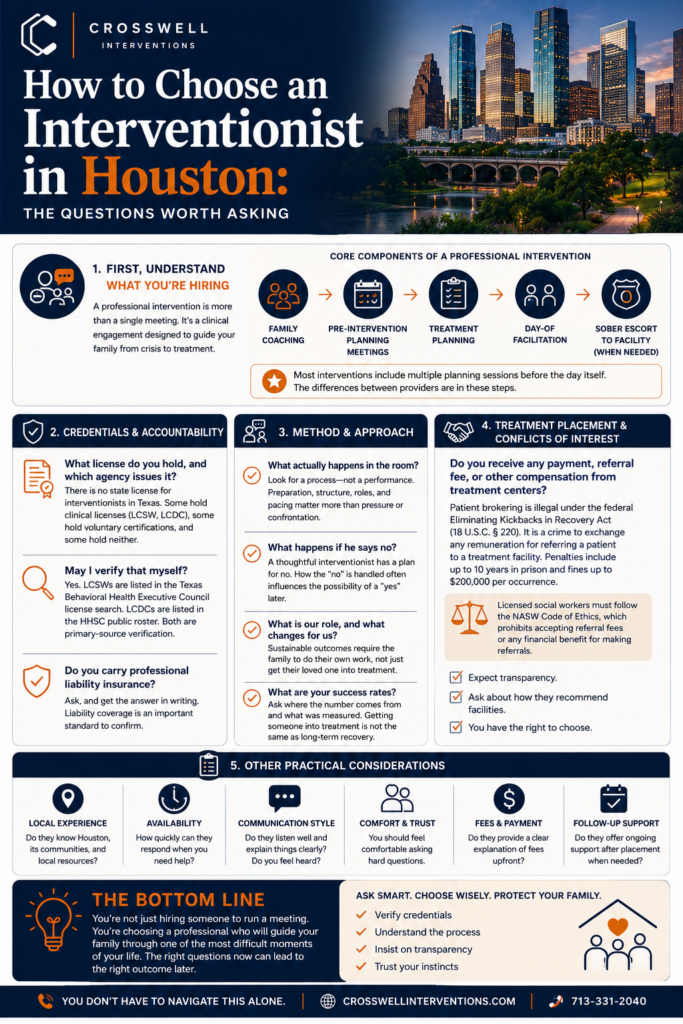
A professional intervention is closer to a short clinical engagement. Practitioners in the field describe the core components as family coaching, pre-intervention planning meetings, treatment planning, day-of facilitation, and in many cases a sober escort to the facility afterward. Most professional interventions include at least one structured pre-intervention planning meeting and often several calls or sessions before the day itself.
That framing matters for every question that follows, because most of the differences between one interventionist and another live in the parts of the process you were not picturing.
Credentials and accountability
“What license do you hold, and which agency issues it?”
There is no state license for interventionists in Texas. Some interventionists hold voluntary certifications, some hold clinical licenses such as LCSW or LCDC, and some hold neither. Our post on what LCSW and LCDC actually require walks through the differences.
A good answer names a specific credential and a specific issuing body without hesitation. A vaguer answer is not proof of anything, but it is worth noticing.
“May I verify that myself?”
Any licensed clinician in Texas should welcome this. Social workers appear in the Texas Behavioral Health Executive Council’s public license search, which the agency states constitutes primary-source verification. Licensed chemical dependency counselors appear in the Health and Human Services Commission’s public roster, and HHSC separately publishes enforcement actions. Both checks take about a minute.
“Do you carry professional liability insurance?”
Ask, and get the answer in writing. Practitioners in the field describe liability coverage as an important thing for families to confirm before hiring.
Method and approach
“What actually happens in the room?”
Listen for a process rather than a performance. You want to hear about preparation, structure, roles, and pacing. Clinicians at Boston Medical Center’s Grayken Center for Addiction have described the “rock bottom” framing that underpins many high-pressure approaches as actively troubling, because it pushes families toward distance at the moment closeness matters most.
“What happens if he says no?”
This is the question families are most afraid to ask and one of the most revealing. A thoughtful interventionist has a plan for no, because no happens, and because how the no is handled often shapes whether there is a yes three weeks later.
“What is our role, and what changes for us?”
An intervention that places someone and changes nothing about the household is often a temporary result. Good answers involve the family doing work of their own.
“What are your success rates?”
Ask, and then ask the follow-up: where does that number come from, and what did it count?
Success figures circulate widely in this industry. You will see claims that as many as ninety percent of interventions succeed in getting someone into a program, usually with no study named and no definition of what counted as success. Getting a person through the door of a facility is not the same as sustained recovery. A professional who cites their own tracked outcomes, says what they measured, and acknowledges the limits of the number is telling you something good about how they work.
Treatment placement and conflicts of interest
This is the section most families do not know to ask about, and it may be the most important.
“Do you receive any payment, referral fee, or other compensation from treatment centers?”
Patient brokering, the practice of steering people toward facilities that pay for the referral, is a documented problem in the addiction treatment industry, serious enough that Congress addressed it directly. The Eliminating Kickbacks in Recovery Act, passed in 2018 as part of the SUPPORT Act and codified at 18 U.S.C. § 220, makes it a federal crime to solicit, receive, pay, or offer any remuneration in exchange for referring a patient to a recovery home, clinical treatment facility, or laboratory. It applies across all payors, including private insurance, and carries penalties of up to ten years in prison and fines of up to $200,000 per occurrence.
Licensed social workers are separately bound by Section 1.16(c) of the NASW Code of Ethics, which prohibits giving or receiving payment for a referral when the referring social worker provides no professional service.
The answer you want is a clear no. Not “we have relationships with facilities we trust,” which may be entirely innocent but does not answer the question. A clear no, and ideally in writing.
“How will you choose where he goes?”
You are listening for clinical fit. Does the facility treat co-occurring mental health conditions if that is relevant? What level of care, and why that level? Is there medical detox capacity if withdrawal is a risk, which it can be with alcohol and benzodiazepines? Does the program handle the substance actually involved, which in Texas increasingly means stimulants rather than opioids?
“How many options will we see?”
More than one, with reasoning attached, is a healthy sign.
Cost and logistics
“What does the fee include, and what triggers additional charges?”
Fees in this field vary widely, and comparing two quotes is close to meaningless without knowing what sits inside each one. Practitioners themselves advise families to confirm pricing and scope in writing, including what the base fee covers and what circumstances generate additional charges. Travel is a common one: work outside a practitioner’s local area can add time, transportation, and lodging costs.
Ask specifically whether each of the following is included or billed separately:
- Pre-intervention family sessions and coaching
- Treatment research and placement coordination
- [Sober transport][CONFIRM] to the facility
- Travel and lodging if anyone has to move
- Day-of contingency time if the conversation runs long
- Any family support after the placement
“How quickly can this happen?”
Timelines vary with complexity. A professional should be able to tell you what determines the answer in your case rather than quoting a generic figure.
“What happens after he is placed?”
The weeks following a placement are when families most often unravel, and when the patterns that surrounded the addiction quietly reassert themselves. Ask what continued support looks like and whether it costs extra.
Answers that should give you pause
None of these proves bad faith. All of them are worth slowing down over.
- Reluctance to name a credential or an issuing body
- Guaranteed outcomes, or success rates offered without a source
- A single treatment facility recommended before anyone has assessed the situation
- Any suggestion that you should wait until things get worse
- Pressure to commit on the first call
- A flat fee with no written scope
- No plan for what happens if the answer is no
What a good first call feels like
You should end it knowing more than you did going in, including about things you had not thought to ask. You should have been asked questions yourself, quite a few of them, about history, about who is in the family, about what has already been tried, about medical risks. You should not feel sold to. And you should feel some of the weight shift, not because anything has been fixed, but because someone competent now has a hand on it.
One thing not to wait for
Somewhere in this process, someone will probably tell you that your loved one has to hit rock bottom first.
Credible voices in the field reject that. The Addiction Policy Forum, a national nonprofit, describes families as being wrongly told to wait for rock bottom, and points to research indicating that treatment works about as well for people who begin under outside pressure as for those who arrive self-motivated. Clinicians at Boston Medical Center have argued the same, noting that people with substance use disorders benefit from intervention and early treatment.
If you are wondering whether it is too soon to call anyone, it very likely is not.
How Crosswell Interventions helps Houston families
Crosswell Interventions is a clinician-led practice led by Will Crosswell, who is an LCSW and LCDC in Texas, a Love First Certified Clinical Interventionist, and EMDR-trained, with more than a decade of experience helping families navigate addiction and mental health crises. Both Texas licenses can be checked in the public state systems named earlier in this article.
The work follows the Crosswell Method, a five-phase framework built on the understanding that an intervention is a clinical process rather than a single event:
- Listening. Understanding the family, the history, and what has already been tried, before anything gets planned.
- Invitation. Approaching your loved one with dignity rather than ambush, so a yes is a decision instead of a surrender.
- Planning. Roles, logistics, treatment options, and contingencies built in advance, including a plan for no.
- Treatment transition. Moving from the room to the appropriate level of care, with [sober transport][CONFIRM] where it is needed.
- Ongoing family support. Continued work with the family after placement, because the system around the addiction has to change too.
Crosswell offers drug and alcohol intervention services in Houston and across the wider metro area, including mental health interventions and alcohol intervention support in Houston. Treatment placement coordination is part of the process rather than a separate service. Will’s full clinical background is on the Who We Are page.
Frequently Asked Questions
What determines how much an intervention costs? Fees vary widely between providers, and the biggest driver of the difference is scope rather than the meeting itself. Practitioners advise families to confirm pricing in writing, including what the base fee covers and what generates additional charges. Travel is a common add-on, since work outside a practitioner’s local area can add time, transportation, and lodging. Before comparing quotes, ask each provider whether family sessions, treatment placement coordination, sober transport, and post-placement support are included or billed separately.
Should the interventionist choose the treatment center? An interventionist should present options with clinical reasoning attached, not a single predetermined facility. Ask directly whether they receive any payment or referral fee from treatment centers. Federal law, specifically the Eliminating Kickbacks in Recovery Act at 18 U.S.C. § 220, makes it a crime to solicit, receive, pay, or offer compensation for referring a patient to a treatment facility, and licensed social workers are additionally bound by NASW Code of Ethics Section 1.16(c), which prohibits payment for referrals where no professional service is provided.
What if my loved one refuses treatment? Refusal happens, and a professional should have a plan for it before the day arrives. How a no is handled often shapes whether there is a yes weeks later. Ask any interventionist you are considering what their approach is when someone declines, and be cautious of anyone who suggests it never happens.
How quickly can an intervention happen in Houston? It depends on the complexity of the case, how many family members need to be prepared, and whether medical detox or a specialized level of care is required. Rather than a generic timeline, ask what specific factors would determine the schedule in your situation.
Do interventionists work with mental health crises as well as addiction? Some do and some do not, and it depends heavily on clinical training. Situations involving depression, bipolar disorder, psychosis, or unresolved trauma alongside substance use require an interventionist equipped to recognize and account for both. If a mental health condition is part of your situation, ask directly about the professional’s clinical qualifications for it.
A closing note
There is no version of this week that feels good. But the decision in front of you is one you can actually get right, and the questions above are the whole toolkit. You do not need to become an expert in behavioral health. You need to ask a handful of direct questions and pay attention to how someone answers them.
Whoever you end up choosing, the way they handle being asked will tell you a great deal about how they will handle your family.
About the Author
Will Crosswell is a Licensed Clinical Social Worker (LCSW) and Licensed Chemical Dependency Counselor (LCDC) in Texas, a Love First Certified Clinical Interventionist, and EMDR-trained. He has more than a decade of experience helping families navigate addiction and mental health crises.