There is a particular kind of exhaustion that shows up in families on their second or third attempt.
The first time, there was fear and then relief. Someone went to treatment. Thirty days, sixty, ninety. There were phone calls that sounded hopeful. Then a return home, a few good weeks, and a slow slide back to somewhere that looked a lot like where things started.
By the second or third time, the fear is still there but the relief is gone, and something harder has replaced it. Families in this position often conclude that treatment does not work, or that their loved one does not want to get better.
Sometimes there is a different explanation. Sometimes only half the problem was ever treated.
What "co-occurring" actually means
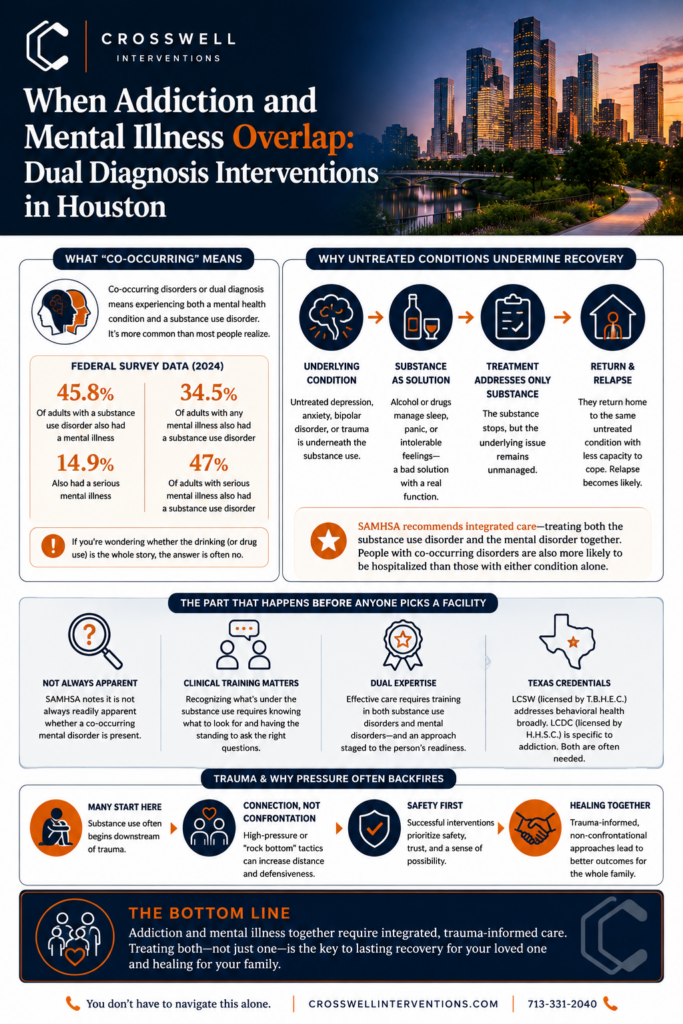
Clinicians use the terms co-occurring disorders and dual diagnosis to describe someone experiencing both a mental health condition and a substance use disorder. The pattern is not unusual. It is closer to the norm.
Federal survey data from 2024 puts numbers on it. Of the 46.3 million American adults who had a substance use disorder in the past year, 45.8 percent also had a mental illness, and 14.9 percent had a serious mental illness. Looked at from the other direction, of the 61.5 million adults with any mental illness, 21.2 million, about 34.5 percent, also had a substance use disorder. Among adults with serious mental illness, the overlap rises to roughly 47 percent.
So if you are a family wondering whether the drinking is the whole story, the statistical answer is that it very often is not.
Why an untreated condition undoes a good placement
Here is the sequence that plays out over and over.
Someone drinks heavily, or uses stimulants, and underneath it there is untreated depression, an anxiety disorder, bipolar disorder, or unprocessed trauma. The substance is doing something. It is managing sleep, or flattening panic, or making an intolerable feeling briefly tolerable. It is a bad solution with a real function.
That person goes to a program that treats the substance. The substance stops. The function it was serving does not go away, and now it is unmanaged. Ninety days later they come home to the same untreated condition and considerably less capacity to sit with it.
This is why federal health authorities treat integrated care as the standard rather than an upgrade. The Substance Abuse and Mental Health Services Administration is direct about it: integrated care is recommended, the presence of two or more disorders complicates diagnosis and treatment, and integrating both screening and treatment produces better quality of care. SAMHSA’s own guidance describes integrated care as combining interventions for the substance use disorder and the mental disorder within a single session or series of sessions, and calls it a best practice. The agency also notes that people with co-occurring disorders are more likely to be hospitalized than people with either condition alone.
Treating the two things in sequence, addiction now and mental health later, is a common arrangement. It is not the one the evidence points toward.
The part that has to happen before anyone picks a facility
Here is a line from SAMHSA’s guidance for clinicians that matters enormously for families: it is not always readily apparent whether a co-occurring mental disorder is present.
Read that again in the context of hiring someone. If it is not always apparent to trained clinicians, it is certainly not going to be apparent to a family in crisis, and it is not going to be apparent to someone working from a script.
This is the specific point where clinical training in an interventionist stops being a credential on a website and starts changing outcomes. Recognizing that a substance use disorder is sitting on top of something else requires knowing what to look for and having the standing to ask. The same guidance notes that providers delivering integrated care should be trained in the treatment of both substance use disorders and mental disorders, and that the approach should be staged to a person’s readiness rather than applied uniformly.
There is a related distinction worth understanding. In Texas, an LCSW is licensed by the Texas Behavioral Health Executive Council on the strength of a master’s degree in social work, supervised clinical experience, and the ASWB clinical examination. An LCDC is licensed separately by the Health and Human Services Commission and is specific to chemical dependency. One credential is oriented to behavioral health broadly, the other to addiction specifically. For a co-occurring situation, both bodies of knowledge are in play at once. Our post on what these credentials require covers the details.
Trauma, and why pressure often backfires
For a meaningful number of people, substance use began downstream of something that happened to them.
That changes what an intervention should look like. Clinicians at Boston Medical Center’s Grayken Center for Addiction have described the “rock bottom” idea as actively troubling, because it pushes families toward distance at exactly the point where distance raises the risk of overdose and death. High-pressure tactics built on that premise may produce a yes in the room. What they often do not produce is the sustained cooperation that treatment requires, and for someone whose substance use is trauma-linked, being cornered by the people they trust most can reinforce the original injury rather than interrupt it.
A trauma-informed approach is slower and less dramatic. It is also more likely to hold.
Will Crosswell is EMDR-trained. It is worth being precise about what that means, because this is an area where claims get inflated. EMDR, or eye movement desensitization and reprocessing, is a psychotherapy developed for post-traumatic stress disorder. The American Psychological Association’s clinical practice guideline includes a conditional recommendation for it as a second-line PTSD treatment, and the Department of Veterans Affairs and Department of Defense list it as a best practice for veterans with PTSD. Whether EMDR specifically helps people with both substance use disorders and PTSD is still an active research question rather than a settled one.
So the relevant claim is not that EMDR treats addiction. It is narrower and more useful than that: a clinician trained in a trauma therapy is a clinician who has been taught to look for trauma, to recognize what it does to a nervous system, and to plan accordingly. In an intervention, that shows up as pacing, language, and who is in the room.
Matching the placement to the person
Once someone says yes, the next decision is where they go, and this is where a co-occurring situation can quietly go wrong.
Questions worth asking about any proposed facility:
- Does it treat mental health conditions concurrently, or is it substance-only with a mental health referral attached?
- Is there psychiatric capability on site, and access to medication management?
- If withdrawal is a medical risk, which it can be with alcohol and benzodiazepines, is there appropriate medical detox capacity?
- Does the program treat the substance actually involved? In Texas this increasingly means stimulants: federal data compiled by USAFacts shows methamphetamine was involved in about 42 percent of Texas overdose deaths in 2024, more than any other single drug, and stimulant use does not present or respond like opioid use.
- What is the discharge plan, and does it include continued mental health care rather than only recovery support?
A single recommended facility offered before anyone has assessed the situation is worth pausing over.
When it is a mental health crisis rather than a substance crisis
Sometimes the substance use is the visible layer and the urgent problem is underneath it. Psychosis, mania, or acute suicidal risk is a different situation requiring a different response, and a substance-focused program is not the right destination for it.
If someone is in immediate danger, that is an emergency. The 988 Suicide and Crisis Lifeline is available by call or text at 988 in the United States, and 911 remains appropriate where there is immediate risk to life.
For situations that are serious but not immediately dangerous, the question to ask any professional you are considering is a plain one: what are your qualifications for the mental health side of this, specifically?
What the numbers say about waiting
There is a widely held belief that a person has to lose everything before help can work. Credible voices in the field reject it. The Addiction Policy Forum, a national nonprofit, describes families as being wrongly told to wait for rock bottom and points to research indicating that treatment works about as well for people who enter under outside pressure as for those who arrive self-motivated.
The treatment gap gives the point some weight. Of the people aged 12 or older in 2024 who were classified as needing substance use treatment, only about one in five received any. Among adolescents with both a major depressive episode and a substance use disorder, 27.9 percent received neither substance use treatment nor mental health treatment.
The dominant failure in this country is not intervening too early. It is not intervening at all.
How Crosswell Interventions helps Houston families
Crosswell Interventions is a clinician-led practice led by Will Crosswell, who is an LCSW and LCDC in Texas, a Love First Certified Clinical Interventionist, and EMDR-trained, with more than a decade of experience helping families navigate addiction and mental health crises. Both Texas licenses can be checked in the public state systems named in this article.
The work follows the Crosswell Method, a five-phase framework built on the understanding that an intervention is a clinical process rather than a single event:
- Listening. Understanding the family, the history, and what has already been tried, before anything is planned. In a co-occurring situation this is also where the second condition tends to surface.
- Invitation. Approaching your loved one with dignity rather than ambush, so a yes is a decision rather than a surrender.
- Planning. Roles, logistics, treatment options, and contingencies built in advance, including a plan for no.
- Treatment transition. Moving from the room to the appropriate level of care, with sober transport where it is needed.
- Ongoing family support. Continued work with the family after placement, because the system around the addiction has to change too.
Crosswell offers mental health interventions and drug and alcohol intervention services in Houston and across the wider metro area, along with family recovery coaching. If you are still deciding who to work with, our guide to the questions worth asking before you hire may help. Will’s full clinical background is on the Who We Are page.
Frequently asked questions
What is a dual diagnosis intervention? It is an intervention planned with the understanding that both a substance use disorder and a mental health condition are present. In practice that affects the assessment, the way the conversation is paced, and above all the treatment placement, since a facility that treats only the substance leaves the other condition unaddressed. Federal health guidance treats integrated care, meaning both conditions addressed together, as the recommended standard rather than an optional extra.
How common is it for addiction and mental illness to occur together? Common enough to be the expectation rather than the exception. In 2024, of the 46.3 million American adults with a substance use disorder in the past year, 45.8 percent also had a mental illness and 14.9 percent had a serious mental illness. Among adults with serious mental illness, roughly 47 percent also had a substance use disorder.
Does treatment have to address both conditions at once? Federal health authorities say integrated care is recommended, and describe combining interventions for both conditions within a single session or series of sessions as a best practice. Treating one condition and referring the other out is common in practice but is not what the guidance points toward. People with co-occurring disorders are also more likely to be hospitalized than people with either condition alone.
What if it is a mental health crisis rather than an addiction crisis? If someone is in immediate danger, treat it as an emergency. The 988 Suicide and Crisis Lifeline is available by call or text at 988, and 911 is appropriate where there is immediate risk to life. For serious but not immediately dangerous situations, ask any professional you are considering what their specific clinical qualifications are for the mental health side.
How does trauma change the approach to an intervention? For many people substance use began as a response to something that happened to them, which means confrontational tactics can reinforce the original harm rather than interrupt the substance use. A trauma-informed approach moves more slowly and pays closer attention to language, pacing, and who is present. Clinicians at Boston Medical Center have described “rock bottom” framing as troubling precisely because it encourages families to withdraw at the moment closeness matters most.
A closing thought
Will Crosswell is a Licensed Clinical Social Worker (LCSW) and Licensed Chemical Dependency Counselor (LCDC) in Texas, a Love First Certified Clinical Interventionist, and EMDR-trained. He has more than a decade of experience helping families navigate addiction and mental health crises.