The Dallas area has become one of the clearest examples in Texas of how counterfeit pills can reach young people, and how quickly that can turn tragic. For parents in North Texas, this is not an abstract national story. It has happened in local neighborhoods and local schools. This guide is meant to explain, calmly, how these pills circulate here, what to watch for, and what a parent can actually do. The goal is not to frighten you. It is to help you feel prepared.
What has happened in North Texas
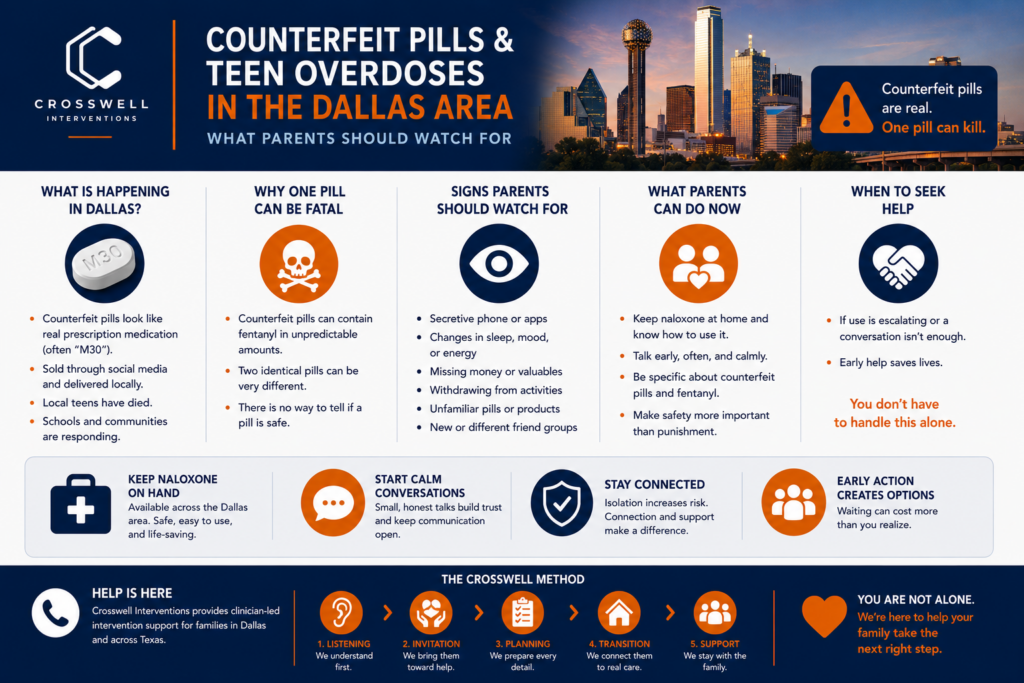
The Dallas suburbs saw a case that drew national attention: a local counterfeit pill operation was linked to the deaths of several area teenagers over a short period. The pills involved were made to look like legitimate prescription medication, often pressed and stamped to resemble oxycodone, sometimes referred to by the marking “M30.” They looked real. They were not, and some contained fentanyl.
That case was not an isolated fluke. It reflected a broader pattern in which counterfeit pills are marketed and sold to young people through social media, arranged as casually as any other online purchase and delivered locally. What made North Texas notable was how visibly the harm concentrated among teenagers, which is exactly why local families and schools began paying closer attention.
Since those cases, many North Texas districts and parent groups have worked to raise awareness, and some campuses now keep naloxone on hand. That response matters, but it does not replace what happens at home. Schools can teach and prepare, yet the conversations that most shape a teenager’s choices still tend to happen at the kitchen table, which is where a parent’s steady, informed presence carries the most weight.
Why one pill can be fatal
A counterfeit pill is not made under any pharmacy’s standards. Two pills that look identical, even from the same batch, can contain very different amounts of fentanyl, which is potent in tiny quantities. There is no taste, no smell, and no way to see the difference. A teenager who believes they are taking something familiar, maybe to study, to sleep, or to manage stress, has no way to know what is actually in it.
This is why experience offers no protection. A young person who has taken a similar-looking pill before without harm can be caught out by the next one, because the next one is a different pill entirely. The pill that seemed fine a dozen times gives no warning about the thirteenth. When people say one pill can kill, in North Texas that has been literally true, and the families who learned it did not think it could happen to them either.
Signs parents should watch for
There is no single tell, and this is not a checklist to interrogate against. But these are worth noticing:
- Pills, powders, or vape products that did not come from a pharmacy
- New secrecy around a phone, or messages that disappear
- Sudden changes in sleep, energy, mood, or friend groups
- Money or valuables going missing
- Unfamiliar apps, or accounts your teen is unusually protective of
- Pulling away from family routines and activities they used to enjoy
Any one of these can have an ordinary explanation, and most teenagers who guard their phones are not buying pills. The point is not to build a case, and treating normal adolescence as evidence tends to push a teenager away rather than closer. The point is to stay close enough to notice a real change, and to keep the relationship open enough that your child can come to you when something is genuinely wrong.
What to do instead of panicking
Fear tends to make teenagers shut down. A few approaches work better.
Keep naloxone in the home and make sure everyone knows where it is and how to use it. It is widely available across the Dallas area, it is safe, and in an opioid overdose it can be the difference between a scare and a loss. Talk early and often, in small, calm conversations rather than one dramatic confrontation, and be specific about counterfeit pills rather than vague about “drugs,” because the concrete fact that a real-looking pill can be fatal is what actually lands with a teenager. Make it clear that your child can call you from any situation, including one where they broke a rule, without the first response being punishment. In an emergency, a young person who is afraid of getting in trouble may hesitate to call for help, and that hesitation is exactly what turns a survivable moment into a tragedy. Safety has to come first. If you do find pills or discover that your child has used, try to respond to the fact rather than to the fear. A calm, direct reaction, one that treats it as a serious health matter rather than a betrayal, keeps the door open for the harder conversations that need to follow. An explosion of anger, however understandable, usually teaches a teenager only to hide better next time.
It also helps to talk with other parents. Counterfeit pills spread through peer networks, and so does good information. Comparing notes with the parents of your child’s friends, without turning it into surveillance, builds a wider net of adults who are paying attention. Keeping a young person connected to trusted adults, rather than isolated with a secret, is one of the most protective things a family can do.
When a conversation is not enough
Sometimes a family is past prevention, and a young person is already using in a way that is escalating. A calm talk may not be enough, and that is not a failure. It is a signal to bring in help. Our guides on the signs it may be time for an intervention and how to talk to someone who refuses help can help you tell the difference. For the wider statewide context on counterfeit pills, see our piece on One Pill Kills in Texas, and for the local overdose picture, our overview of fentanyl in Dallas County.
Waiting for a young person to hit rock bottom is especially dangerous here, because with fentanyl in counterfeit pills, rock bottom can be the first serious mistake. We have written more about the real cost of waiting.
How Crosswell Interventions helps Dallas-area families
We provide clinician-led professional intervention services in Dallas and across Texas, including interventions for young adults, from the first worried phone call through treatment placement and family coaching. Our approach with young people is trauma-informed and developmentally aware, built around the Crosswell Method: listening first, inviting rather than cornering, planning carefully, transitioning into real care, and supporting the whole family afterward. Young people rarely respond to pressure. They respond to feeling understood and safe.
Frequently Asked Questions
Are counterfeit pills a problem in Dallas schools? Counterfeit pills have reached teenagers in the Dallas area, including cases connected to local schools and neighborhoods. They are typically arranged through social media rather than in person, which means proximity to a school is less the issue than access to a phone.
What do fake M30 pills look like? They are often pressed and stamped to resemble real oxycodone tablets, including the “M30” marking. They can look convincingly like genuine medication, and there is no reliable way to tell by sight, taste, or smell whether a pill contains fentanyl or how much.
How do I talk to my teen about fentanyl? Be specific and calm rather than alarmist. Explain that counterfeit pills can contain fentanyl in unpredictable amounts, that this has happened locally, and that your first concern in any emergency is their safety, not punishment. Small, repeated conversations tend to work better than one big lecture.
Should I keep naloxone at home even if I am not sure my teen is using? Many families choose to, and it is reasonable. Naloxone is safe, widely available in the Dallas area, and can reverse an opioid overdose. Given how counterfeit pills have affected local teens, having it on hand is a low-cost precaution.
A final thought
Counterfeit pills have changed what a single mistake can cost, and in North Texas that change has been painfully visible. But parents are not powerless. Staying close, talking plainly, keeping naloxone within reach, and acting early rather than waiting all make a real difference. If you are worried about your child, that worry is worth trusting, and it is worth acting on. Parents often second-guess themselves, not wanting to overreact or to accuse unfairly, but in a landscape where a single pill can be fatal, erring toward attention and connection is far safer than waiting for certainty that may never come.
This is a sensitive topic. If you are struggling with fear or grief connected to a loved one’s substance use, you do not have to navigate it alone, and support is available.
About the Author
Will Crosswell is a Licensed Clinical Social Worker (LCSW), Licensed Chemical Dependency Counselor (LCDC), and EMDR-trained clinician with more than ten years of experience helping families navigate addiction and mental health crises. His clinical training in trauma-informed care and family systems work informs the Crosswell Method’s approach to mental health intervention specifically. Crosswell Interventions is independent and does not accept referral fees from treatment facilities.