Most of the attention in Austin has gone to fentanyl, and for good reason. But the local story has quietly shifted. As fentanyl deaths fell across Travis County, methamphetamine moved to the top of the list, becoming the leading substance in the county’s accidental drug deaths. If your family has been watching only for opioids, this is the piece of the picture you may be missing, and it is worth understanding on its own terms rather than as a footnote to the fentanyl story.
What changed in Austin
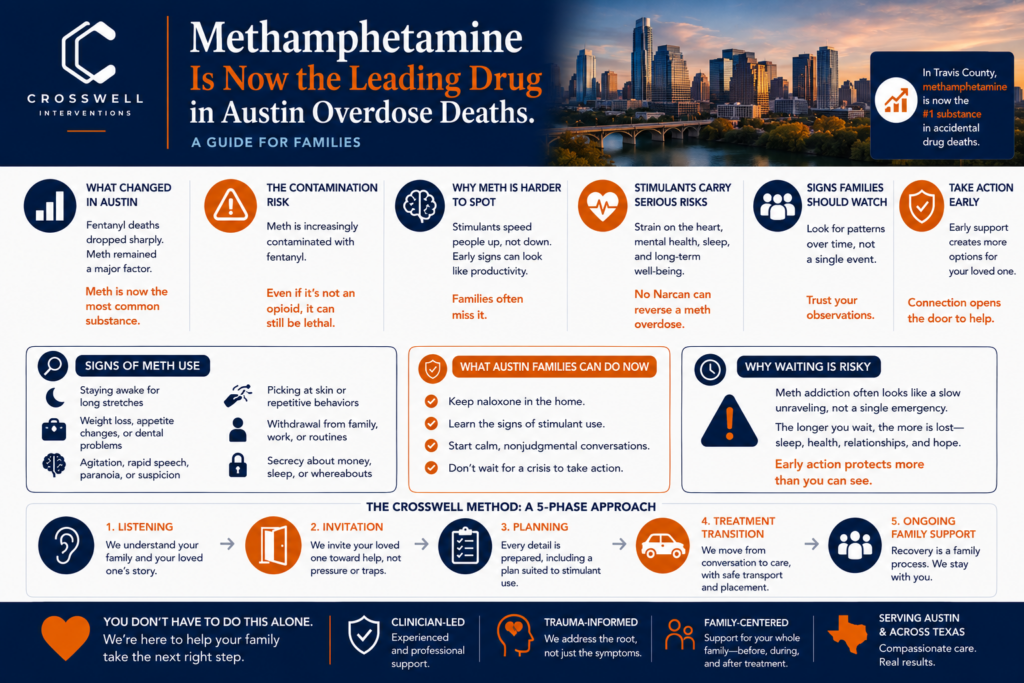
Two things happened at once. Fentanyl deaths dropped sharply, thanks largely to widespread naloxone distribution, which we cover in our companion piece on why Austin’s overdose deaths are falling. At the same time, methamphetamine remained a persistent and heavy presence. Even as the raw number of meth-involved deaths came down from its own peak, meth rose to become the most common substance in Travis County accidental drug deaths, because fentanyl fell faster.
That is an important nuance. “Meth is now number one” does not mean meth is exploding. It means the mix shifted, and it means a family reassured by the fentanyl headlines could easily overlook the drug that now leads. Deaths have also concentrated in certain parts of the county, including South Austin, a reminder that a county average hides a lot of local variation.
The shift also reflects a broader pattern across Texas, where stimulant use has been climbing for years even as opioids dominated the headlines. Austin is not an exception to the state trend so much as an early, visible example of it. For families, the practical consequence is that the mental model built during the fentanyl years, watching for pills and for the signs of opioids, is now incomplete.
Why methamphetamine is different, and why families miss it
Meth is a stimulant, and it behaves nothing like an opioid. There is no naloxone for meth. The overdose-reversal medication that lowered Austin’s fentanyl deaths does nothing for the stimulant itself. That alone changes the safety picture for a family.
The signs are different too. Opioid use often shows up as sedation and slowing down. Stimulant use tends to show up as the opposite: long stretches without sleep, a racing mind, weight loss, agitation, and sometimes paranoia. Families who have learned to watch for the drowsy, nodding signs of opioids can miss a meth problem entirely, because it looks like restlessness, overwork, or a personality change rather than a drug. In the early stages, meth use can even masquerade as something a family might not worry about at all, such as suddenly having boundless energy, working long hours, or losing weight. By the time the harder signs appear, the use may be well established.
Methamphetamine also carries its own long-term risks, including strain on the heart, damage to mental health, and the steady erosion of sleep and nutrition over time. And because Austin’s supply is mixed, meth is increasingly contaminated with fentanyl, which means a person who uses only meth can still be exposed to an opioid overdose without ever intending to be.
Signs families should recognize
These signs, especially in combination, are worth taking seriously:
- Staying awake for long stretches, then crashing for extended periods
- Marked weight loss, changes in appetite, or dental problems
- Agitation, rapid speech, paranoia, or unusual suspiciousness
- Picking at skin, or repetitive, driven behavior
- Withdrawal from family, work, or routines
- New secrecy about money, sleep, or whereabouts
No single sign proves anything on its own, and several of these have ordinary explanations. But a cluster that appears together and persists over time is worth paying attention to, and worth trusting even when the person insists everything is fine.
Why stimulant addiction needs its own approach
Because there is no reversal medication and no single approved medication that treats stimulant use disorder the way certain medications support opioid recovery, treatment leans heavily on behavioral approaches, structure, and sustained support. That is not a reason for discouragement. People recover from stimulant use disorder all the time, and treatment that combines structure, support, and time works. It does mean that the plan looks different from an opioid plan, and that a knowledgeable, individualized approach matters, since a program built around opioid recovery will not automatically fit a person whose primary substance is a stimulant.
It also means that waiting for a dramatic overdose as the signal to act is a poor strategy, because a meth crisis often looks like a slow unraveling rather than a single emergency. The decline can be gradual enough that a family keeps adjusting to it until a great deal of ground has been lost. Sleep, work, relationships, and physical health tend to erode in stages, and each stage can feel like the new normal. Naming the pattern early, before it deepens, is one of the most useful things a family can do.
What Austin families can do right now
Keep naloxone in the home even if you believe only meth is involved, because contamination with fentanyl is common and naloxone can still matter. Learn the specific signs of stimulant use, which differ from what most people picture when they think of drugs. Then, when you are ready, start a calm conversation rather than a confrontation. Expect that a person using meth may be more guarded or suspicious than you anticipate, since paranoia can be part of the picture, and try not to take that personally or let it end the conversation. The goal of a first talk is not agreement. It is to make clear that you see them, that you are not there to attack, and that a door is open whenever they are ready to walk through it.
If you expect resistance, our guide on how to talk to someone who refuses help can help you prepare, and our overview of the signs it may be time for an intervention can help you judge timing. Because waiting so often costs a family its best options, our piece on the real cost of waiting is worth reading as well.
How a professional intervention works for stimulant use
A professional intervention is planned, supported, and compassionate, not an ambush. At Crosswell Interventions we use a five-phase approach, the Crosswell Method, built around connection rather than pressure:
- Listening. We start by understanding the family system and the person’s story before any plan is made.
- Invitation. We bring the person toward help rather than cornering them, so the conversation feels like an open door instead of a trap.
- Planning. Every practical and clinical detail is prepared in advance, including a treatment plan suited to stimulant use.
- Treatment transition. We move from the conversation to actual care, including safe transport and placement.
- Ongoing family support. Recovery is a family process, not a single day, so the work continues after treatment begins.
How Crosswell Interventions helps Austin families
We provide clinician-led intervention support in Austin and across Texas, from the first worried phone call through treatment placement and family coaching. Our work is trauma-informed and family-centered, and we tailor the approach to the substance involved, including the specific realities of stimulant use disorder.
Frequently Asked Questions
Is meth a bigger problem than fentanyl in Austin now? Methamphetamine has become the leading substance in Travis County accidental drug deaths, largely because fentanyl deaths fell faster than meth deaths. That does not mean fentanyl is gone or that meth is surging. It means the mix has shifted, and families should not assume the danger is over because fentanyl numbers improved.
Can Narcan reverse a meth overdose? No. Naloxone reverses opioid overdoses. It does nothing for the stimulant effects of methamphetamine. It is still worth keeping on hand, because Austin’s supply is often mixed and meth can be contaminated with fentanyl.
What are the physical signs of meth use? Common signs include staying awake for long stretches, weight loss, dental problems, agitation or paranoia, rapid speech, and repetitive behaviors. These differ from the sedation associated with opioids, which is part of why families sometimes miss a stimulant problem.
How do you help someone addicted to meth? Treatment for stimulant use disorder relies heavily on behavioral approaches, structure, and sustained support, since there is no reversal drug and no single approved medication that works the way some opioid treatments do. Recovery is very possible; the plan simply looks different, and individualized, professional guidance helps.
A final thought
Austin’s fentanyl progress is real, but it is not the whole story, and methamphetamine now leads the county’s drug deaths. A shift like this is easy to miss precisely because it is quieter than a fentanyl headline. If you are watching someone you love and noticing the signs of stimulant use, that observation matters more than any reassuring county trend. What your own eyes are telling you is worth acting on.
About the Author
Will Crosswell is a Licensed Clinical Social Worker (LCSW), Licensed Chemical Dependency Counselor (LCDC), and EMDR-trained clinician with more than ten years of experience helping families navigate addiction and mental health crises. His clinical training in trauma-informed care and family systems work informs the Crosswell Method’s approach to mental health intervention specifically. Crosswell Interventions is independent and does not accept referral fees from treatment facilities.