
Not long ago, Travis County declared its overdose problem a public health crisis. Today the county is posting one of the most dramatic declines in Texas. That is genuine, hard-won progress, and it deserves to be recognized. It also comes with a caution that matters a great deal if you are worried about someone you love: a falling county number is not a personal all-clear. This article explains what changed in Austin, why it changed, and what families should and should not take from it.
What the Austin numbers show
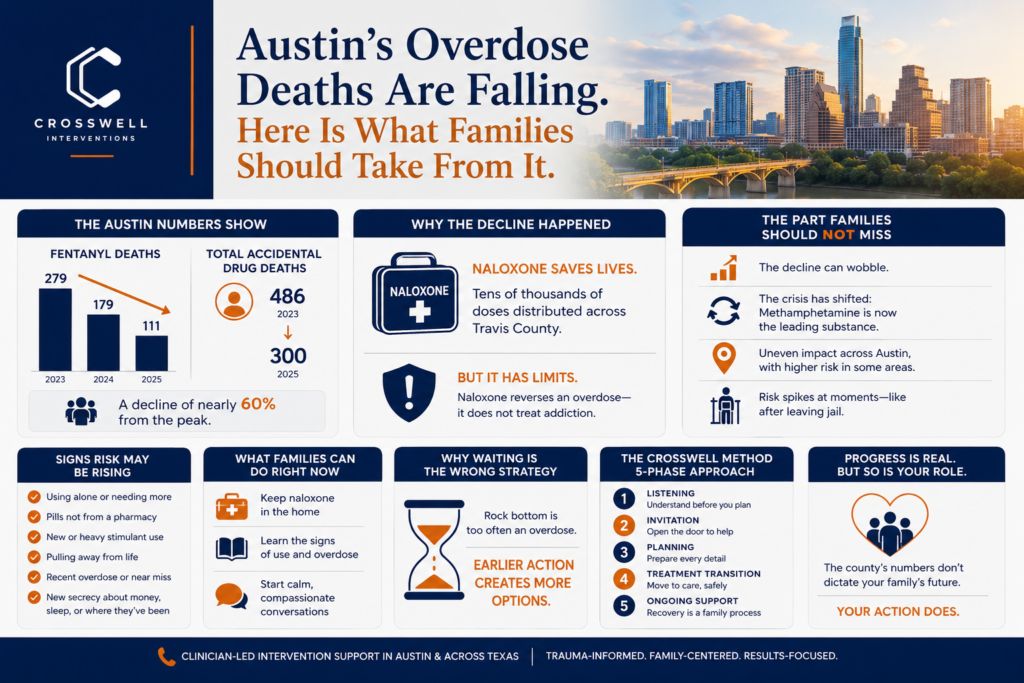
The turnaround is striking. Accidental fentanyl deaths in Travis County fell from about 279 in 2023 to roughly 179 in 2024 and to about 111 in 2025, a decline of close to 60 percent from the peak. Total accidental drug deaths dropped as well, from around 486 in 2023 to roughly 300 in 2025. The share of drug deaths involving fentanyl, which had climbed to nearly 60 percent in 2022, eased back toward the high 40s by 2024.
For a county that not long ago saw the crisis accelerating, this is meaningful movement in the right direction. It is worth pausing to acknowledge that behind these numbers are people who are alive today who might not have been.
Why the decline happened
The most cited reason is naloxone. Travis County and its partners flooded the community with the overdose-reversal medication, distributing tens of thousands of doses through vending machines, community organizations, and outreach to the places and people at highest risk. When naloxone is everywhere, more overdoses are survived, and the death numbers reflect that. The scale of the effort matched the scale of the alarm: after the county formally treated overdose as a public health crisis in 2022, distribution ramped up quickly, and the results showed within a couple of years.
That success also defines the limit. Naloxone reverses an overdose in the moment. It does not treat addiction. As our Austin team has written about why Narcan alone is not enough, a reversal is a rescue, not a recovery. Many people are revived more than once before anything about their circumstances changes. The lifesaving tool that lowered the death count did not, by itself, resolve the underlying disorder for the people it saved.
The part families should not miss
A lower county number can quietly tell a family the wrong thing. Here is what it leaves out.
First, the decline is uneven and can wobble. Improvement has not moved in a straight line anywhere, and a good year does not guarantee the next. Second, and most importantly for Austin, the drugs themselves are shifting. Even as fentanyl deaths fell, methamphetamine rose to become the leading substance in Travis County accidental drug deaths. In other words, the crisis did not end. It changed shape. A family that is watching only for opioids, reassured by the falling fentanyl numbers, may miss a stimulant problem entirely. Deaths have also clustered in specific parts of the county, including South Austin, a reminder that a county average blends very different local realities. Risk also spikes at specific moments in a person’s life. People leaving jail, for example, face a sharply elevated overdose risk in the first weeks after release, because tolerance drops during incarceration while the supply outside stays as potent as ever. A family average cannot capture that kind of individual timing.
The takeaway is not that the progress is fake. It is real. The takeaway is that the progress belongs to the county, not to any one household, and it says nothing about the trajectory of the specific person you are worried about.
Signs the trend may not apply in your home
Instead of watching the county number, watch the person. These are signs that risk may be rising:
- Using alone, or needing more of a substance to feel the same effect
- Taking pills that did not come from a pharmacy, or buying anything through social media
- New or heavy stimulant use, including changes in sleep, appetite, or agitation
- Pulling away from family, work, school, or daily routines
- A recent overdose, a near miss, or an unexplained hospital visit
- New secrecy about money, sleep, or where they have been
No single item proves anything. But if several appear together, the county’s good news is not the number that matters for your family.
What Austin families can do right now
A few steps do not require anyone’s permission. Keep naloxone in the home and learn how to use it, since it is widely available across Travis County and safe to give even when you are not certain opioids are involved. Learn what use and overdose look like, including the signs of stimulant use, so you can respond rather than freeze. Then, when you are ready, start a calm conversation rather than a confrontation. The first talk does not need to solve anything. It needs to open a door, and leading with worry and love rather than accusation keeps that door open.
If you expect resistance, our guide on how to talk to someone who refuses help can help you prepare, and our overview of the signs it may be time for an intervention can help you judge timing.
When to step in, and why waiting is the wrong strategy
There is an old belief that a person has to hit rock bottom before help can work. It is not true, and it can be fatal. Rock bottom, too often, is an overdose. Waiting for someone to lose everything does not make treatment more likely to succeed. It only removes chances along the way. We have written more about the real cost of waiting, and the core of it is simple: the earlier a family acts, the more options everyone keeps.
Acting early does not mean staging an ambush. A professional intervention is planned, supported, and compassionate. At Crosswell Interventions we use a five-phase approach, the Crosswell Method, built around connection rather than pressure:
- Listening. We start by understanding the family system and the person’s story before any plan is made.
- Invitation. We bring the person toward help rather than cornering them, so the conversation feels like an open door instead of a trap.
- Planning. Every practical and clinical detail is prepared in advance, so nothing is left to chance when emotions run high.
- Treatment transition. We move from the conversation to actual care, including safe transport and placement, closing the gap where good intentions often fall apart.
- Ongoing family support. Recovery is a family process, not a single day, so the work continues after treatment begins.
How Crosswell Interventions helps Austin families
We provide clinician-led intervention support in Austin and across Texas, from the first worried phone call through treatment placement and family coaching. Our work is trauma-informed and family-centered, and our goal is to help families act on a clear read of their own situation rather than on a headline. We coordinate the details so that the distance between deciding to help and actually getting a loved one into care does not become the place where everything stalls.
Frequently Asked Questions
Are overdose deaths really going down in Austin? Yes. Travis County fentanyl deaths fell from about 279 in 2023 to roughly 111 in 2025, and total accidental drug deaths dropped as well. County officials credit widespread naloxone distribution for much of the improvement. The decline is real, though it can wobble year to year.
If deaths are falling, should we wait to intervene? No. A county-wide decline does not measure one person’s risk. It reflects thousands of people at once and says nothing about the trajectory of the specific person you are worried about. Waiting tends to narrow a family’s options rather than widen them.
What drug is now most common in Austin overdose deaths? As fentanyl deaths fell, methamphetamine rose to become the leading substance in Travis County accidental drug deaths. This is a key reason families should not assume the crisis is over simply because the fentanyl numbers improved.
Is naloxone enough to keep someone safe? Naloxone can reverse an opioid overdose and it saves lives, which is why Austin’s numbers fell. It does not treat addiction, and it does nothing for a stimulant-only overdose. It is a critical safety tool, not a substitute for treatment and support.
A final thought
Austin’s progress is real, and the people who did the work of distributing naloxone and reaching those at risk deserve credit for lives saved. But a county figure describes a population, not a promise to any one family, and in Austin the crisis has shifted rather than ended. If you are watching someone you love and feeling that quiet, persistent worry, that feeling is more reliable than any chart. The direction of Travis County’s numbers does not change what your own eyes are telling you.
About the Author
Will Crosswell is a Licensed Clinical Social Worker (LCSW), Licensed Chemical Dependency Counselor (LCDC), and EMDR-trained clinician with more than ten years of experience helping families navigate addiction and mental health crises. His clinical training in trauma-informed care and family systems work informs the Crosswell Method’s approach to mental health intervention specifically. Crosswell Interventions is independent and does not accept referral fees from treatment facilities.