Dallas County’s overdose numbers tell a story in two halves. They rose fast, and then they fell. Both halves matter to a family trying to decide whether to worry, and what to do about it. This article walks through what the local data shows, why the recent decline happened, and why “dropping” is not the same as “over.”
What the Dallas County numbers show
The climb was sharp. Dallas County’s overdose death rate surged by roughly 81 percent between 2019 and 2023. Fentanyl was the engine behind it. Across the broader North Texas public health region, fentanyl went from a small share of opioid deaths, around 11 percent in 2018, to the overwhelming majority, close to 80 percent, by 2023. In practical terms, an opioid death in the area became, more often than not, a fentanyl death.
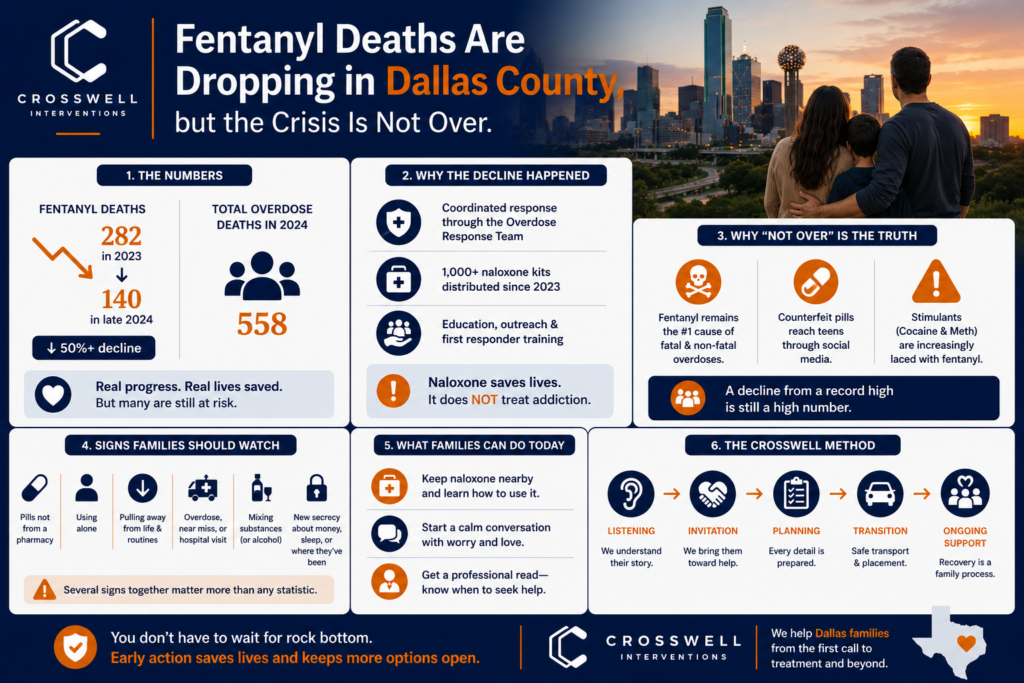
Then the line bent. Dallas County fentanyl deaths fell from about 282 in 2023 to roughly 140 by late 2024, a decline of more than half. Total overdose deaths in the county were around 558 in 2024. That is real, measurable progress, and it did not happen by accident.
Why the decline happened
Dallas County built an active, coordinated response. The county’s Overdose Response Team has carried out thousands of suspected overdose interventions since 2023, distributed more than a thousand naloxone kits, and worked to put the overdose-reversal medication into the hands of first responders, including patrol officers. Public education and hospital-based outreach added to the effort. When naloxone reaches the places where overdoses happen, more people survive, and the county’s numbers reflect that.
There is a limit worth naming, though. Naloxone reverses an overdose. It does not treat addiction. A person can be revived more than once and still be in serious danger, because each reversal is a window, not a resolution. What a family does with that window is what changes the longer story. The county’s own data make the point: even as deaths fell, the number of non-fatal overdoses stayed high, which means many people are surviving close calls without yet reaching treatment.
Why "not over" is the honest headline
Even as deaths fell, fentanyl remained the leading driver of both fatal and non-fatal overdoses in the area. A decline from a record high is still a high number. Behind the roughly 140 fentanyl deaths in 2024 are 140 families, and behind the non-fatal overdoses are many more who are still at risk.
The North Texas region has also seen the human cost concentrate in painful ways. A counterfeit pill operation tied to the Dallas suburbs was linked to the deaths of several local teenagers, part of a broader pattern in which pills made to look like legitimate prescriptions, often stamped to resemble oxycodone, reach young people through social media. A pill that looks familiar can contain fentanyl, and the person taking it may have no idea.
Fentanyl is also not the whole story in Dallas. Methamphetamine and cocaine remain common, and stimulants are increasingly contaminated with fentanyl. A person who believes they only use a stimulant, and who has never thought of themselves as at risk of an opioid overdose, can still die from one. Families who watch only for the signs of opioid use can miss what is actually happening.
Signs families should recognize
Instead of watching the county number, watch the person. These are signs that risk may be rising for someone you love:
- Taking pills that did not come from a pharmacy, or buying anything through social media
- Using alone, or needing more of a substance to feel the same effect
- Pulling away from family, work, school, or daily routines
- A recent overdose, a near miss, or an unexplained hospital visit
- Mixing substances, or mixing substances with alcohol
- New secrecy about money, sleep, or where they have been
No single item proves anything. But if several appear together, that pattern matters far more for your family than the county trend line.
What Dallas families can do right now
A few concrete steps do not require anyone’s permission. Keep naloxone in the home and learn how to use it, since Dallas County has worked hard to make it widely available and it is safe to give even when you are not certain opioids are involved. Learn what use and overdose look like, so you can respond rather than freeze. Then, when you are ready, start a calm conversation rather than a confrontation. The first talk does not need to solve anything. It needs to open a door.
If you expect resistance, our guide on how to talk to someone who refuses help can help you prepare, and our overview of the signs it may be time for an intervention can help you judge timing. Because fentanyl behaves differently across the metroplex, it also helps to understand the wider picture, which we cover in our look at the fentanyl landscape across Dallas-Fort Worth.
When to step in, and why waiting is the wrong strategy
There is an old belief that a person has to hit rock bottom before help can work. It is not true, and with fentanyl in the supply it can be fatal. Rock bottom, too often, is an overdose. Waiting for someone to lose everything does not make treatment more likely to succeed. It only removes chances along the way. We have written more about the real cost of waiting, and the core of it is simple: the earlier a family acts, the more options everyone keeps.
Acting early does not mean staging an ambush. A professional intervention is planned, supported, and compassionate. At Crosswell Interventions we use a five-phase approach, the Crosswell Method, built around connection rather than pressure:
- Listening. We start by understanding the family system and the person’s story before any plan is made.
- Invitation. We bring the person toward help rather than cornering them, so the conversation feels like an open door instead of a trap.
- Planning. Every practical and clinical detail is prepared in advance, so nothing is left to chance when emotions run high.
- Treatment transition. We move from the conversation to actual care, including safe transport and placement, closing the gap where good intentions often fall apart.
- Ongoing family support. Recovery is a family process, not a single day, so the work continues after treatment begins.
How Crosswell Interventions helps Dallas families
We provide clinician-led professional intervention services in Dallas and across Texas, from the first worried phone call through treatment placement and family coaching. Our work is trauma-informed and family-centered, and our goal is to help families act on a clear read of their own situation rather than on a headline. We coordinate the details so the distance between deciding to help and actually getting a loved one into care does not become the place where everything stalls.
Frequently Asked Questions
Are fentanyl deaths going down in Dallas? Yes. Dallas County fentanyl deaths fell from about 282 in 2023 to roughly 140 by late 2024, a decline of more than half, following a steep rise from 2019 through 2023. The improvement is real, though fentanyl remains the leading cause of fatal and non-fatal overdoses in the area.
What is the Dallas Overdose Response Team? It is a county effort that responds to overdose events, connects people to care, and distributes naloxone. Since 2023 it has carried out thousands of suspected overdose interventions and distributed more than a thousand naloxone kits, and it is part of why local deaths declined.
If deaths are falling, is it safe to wait before helping a loved one? No. A county-wide decline does not measure one person’s risk. Fentanyl remains widespread, and any single use can be unpredictable, so waiting tends to narrow a family’s options rather than widen them.
Are counterfeit pills a problem in the Dallas area? Yes. Pills made to look like legitimate prescriptions and sold through social media have been linked to local teen deaths. A pill that looks familiar can contain fentanyl, which is why keeping naloxone on hand and talking openly with young people matters.
Where can Dallas families get naloxone? Naloxone is widely available in Dallas County through pharmacies, community organizations, and county distribution efforts, including the state’s naloxone locator resources. It is safe to carry and administer and can turn a fatal night into a survivable one.
A final thought
The decline in Dallas County is worth acknowledging. It represents people who are alive today because of naloxone and a coordinated local response. But a county figure describes a population, not a promise to any one family. If you are watching someone you love and feeling that quiet, persistent worry, that feeling is more reliable than any chart. The direction of the numbers does not change what your own eyes are telling you, and it does not have to set the timeline for what you do next.
About the Author
Will Crosswell is a Licensed Clinical Social Worker (LCSW), Licensed Chemical Dependency Counselor (LCDC), and EMDR-trained clinician with more than ten years of experience helping families navigate addiction and mental health crises. His clinical training in trauma-informed care and family systems work informs the Crosswell Method’s approach to mental health intervention specifically. Crosswell Interventions is independent and does not accept referral fees from treatment facilities.