Houston is the largest city in the largest county in Texas, and for several years it has carried a heavy share of the state’s fentanyl loss. If you live in Harris County and you are worried about someone you love, you have probably seen the headlines and felt the fear underneath them. This article is meant to do something the headlines usually do not: explain what the local numbers actually say, what they leave out, and how a family can use that understanding to decide when to act.
What the Harris County numbers show
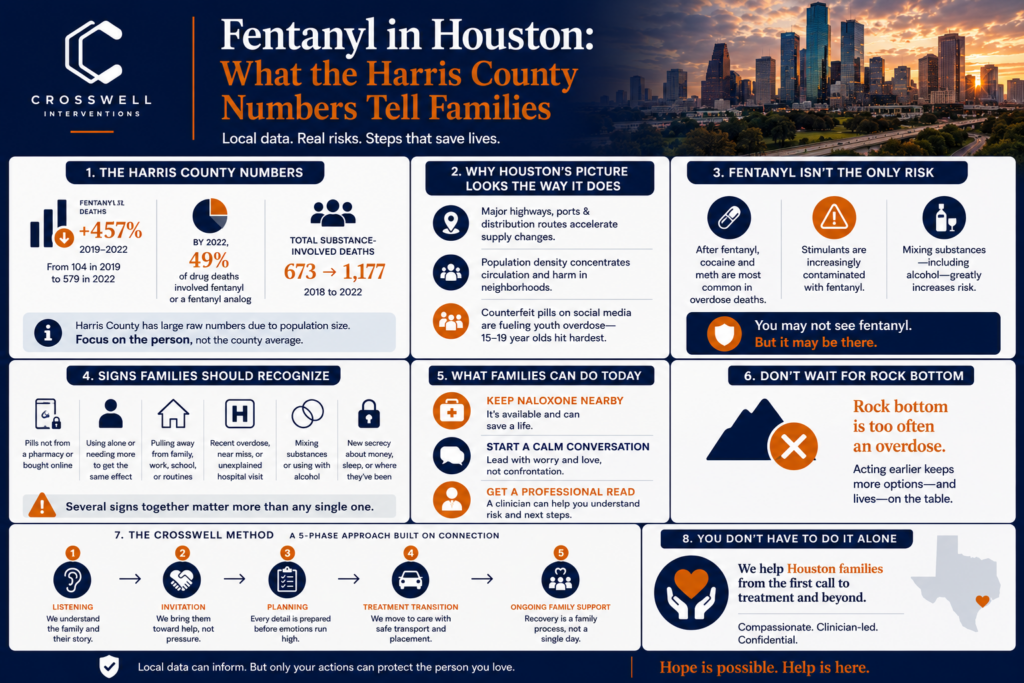
The rise in Houston was steep. According to public health reporting, fentanyl-involved deaths in Harris County increased by about 457 percent over a short span, climbing from 104 in 2019 to 579 in 2022. By 2022, nearly half of all drug-related deaths in the county, about 49 percent, involved fentanyl or a fentanyl analog. Total substance-involved deaths in the county rose from 673 in 2018 to 1,177 in 2022. Those are not small shifts. They describe a supply that changed quickly and a community that felt it.
There is a nuance worth holding onto, because it matters for how you read your own risk. Harris County has among the largest raw death counts in Texas, which makes sense for the most populous county in the state. Its per-capita rate, though, has run lower than several other Texas metros. In other words, Houston’s totals are large partly because Houston is large. This is not a reason to relax. It is a reason to focus on the person in front of you rather than on the county-wide figure, because a rate averaged across millions of people tells you very little about one household.
Why Houston's picture looks the way it does
A few forces shaped the local trend. Houston sits at the intersection of major highways, ports, and distribution routes, which affects how quickly a changing drug supply reaches the region. Density plays a role as well, both in how substances circulate and in how quickly harm concentrates in specific neighborhoods.
The most painful part of the Houston story involves young people. Counterfeit pills, made to look like legitimate prescriptions such as Xanax, Adderall, or Percocet, have reached teenagers and young adults, often through social media. Harris County has recorded some of its highest substance-related healthcare visit rates among people aged 15 to 19. A young person who takes what they believe is a familiar pill can be exposed to fentanyl without any idea it is there. This is why so much of the local prevention effort, including Harris County Public Health’s Substance Use Prevention program and its federally funded overdose response work, has focused on awareness and naloxone access.
Fentanyl is not the only risk in Houston
It would be a mistake to treat this as an opioid-only story. Houston has a long history of polysubstance use, and after fentanyl the most common drugs in local overdose deaths have been cocaine and methamphetamine. Deaths involving stimulants have risen for years.
That combination is dangerous in a specific way. Stimulants are increasingly contaminated with fentanyl, sometimes without the user having any idea. A person who believes they only use cocaine, and who has never thought of themselves as at risk of an opioid overdose, can die from one. Families who are watching only for the signs of opioid use may miss what is actually happening. If drinking is also part of the picture, that raises separate risks, and our Houston team has written more about alcohol and recovery support in Houston for families facing that side of the problem.
Signs families should recognize
Rather than watching the county number, watch the person. These are signs that risk may be rising for someone you love:
- Taking pills that did not come from a pharmacy, or buying anything through social media
- Using alone, or needing more of a substance to feel the same effect
- Pulling away from family, work, school, or daily routines
- A recent overdose, a near miss, or an unexplained hospital visit
- Mixing substances, or mixing substances with alcohol
- New secrecy about money, sleep, or where they have been
No single item proves anything, and this is not a diagnostic checklist. But if several appear together, that pattern is more meaningful for your family than any statistic about the county as a whole.
What Houston families can do right now
Worry without a plan tends to harden into paralysis. A few concrete steps do not require anyone’s permission and can be taken today.
Keep naloxone in the home and learn how to use it. It is available across Harris County through pharmacies, community organizations, and public health distribution, and it is safe to give even when you are not certain opioids are involved. Learn what use and overdose actually look like, so you can respond rather than freeze. Then, when you are ready, start a calm conversation rather than a confrontation. The first talk does not need to fix anything. It needs to open a door, and leading with worry and love keeps that door open. If you expect resistance, our guide on how to talk to someone who refuses help can help you prepare, and our overview of the signs it may be time for an intervention can help you gauge timing. If you would rather talk it through with someone first, a Houston interventionist can help you think about approach before you say anything.
When to step in, and why waiting is the wrong strategy
There is an old belief that a person has to hit rock bottom before help can work. It is not true, and with fentanyl in the Houston supply it can be fatal. Rock bottom, too often, is an overdose. Waiting for someone to lose everything does not make treatment more likely to succeed. It only removes chances along the way.
The decision to act should follow a person’s trajectory, not a public statistic and not a dramatic collapse. We have written before about the real cost of waiting, and the heart of it is simple: the earlier a family acts, the more options everyone keeps.
Acting early does not mean staging an ambush. A professional intervention is planned, supported, and compassionate. At Crosswell Interventions we use a five-phase approach, the Crosswell Method, built around connection rather than pressure:
- Listening. We start by understanding the family system and the person’s story before any plan is made.
- Invitation. We bring the person toward help rather than cornering them, so the conversation feels like an open door instead of a trap.
- Planning. Every practical and clinical detail is prepared in advance, so nothing is left to chance when emotions run high.
- Treatment transition. We move from the conversation to actual care, including safe transport and placement, closing the gap where good intentions often fall apart.
- Ongoing family support. Recovery is a family process, not a single day, so the work continues after treatment begins.
How Crosswell Interventions helps Houston families
We provide clinician-led intervention support for families across Texas, and our drug and alcohol interventionist services in Houston, TX cover the full arc, from the first worried phone call through treatment placement and family coaching. For the statewide view, our overview of drug and alcohol interventions in Texas explains how the process works. Our work is trauma-informed and family-centered, and our goal is to help families act on a clear read of their own situation rather than on a headline. We coordinate the details so that the distance between deciding to help and actually getting a loved one into care does not become the place where everything stalls.
Frequently Asked Questions
How bad is fentanyl in Houston compared to the rest of Texas? Harris County has among the largest raw counts of drug deaths in the state, which is expected for the most populous county, and it saw a very steep rise in fentanyl deaths between 2019 and 2022. Its per-capita rate has run lower than several other Texas metros, so the county’s large totals partly reflect its size. Either way, the risk to an individual depends on that person, not on the county average.
What are the first signs of fentanyl use? There is no single tell. Watch for pills that did not come from a pharmacy, using alone, increasing tolerance, withdrawal from routines, and new secrecy. Because fentanyl is potent in tiny amounts, a change can happen fast, which is part of why families are encouraged not to wait for certainty before starting a conversation.
My teenager may be buying pills online. What should I do? Take it seriously, and keep naloxone in the home. Counterfeit pills sold through social media have driven youth deaths in Harris County, and a pill that looks legitimate can contain fentanyl. Approach your teen with concern rather than accusation, and consider a professional assessment, since young people often need a different, developmentally aware approach.
Is cocaine in Houston really a fentanyl risk? Yes. Stimulants are increasingly contaminated with fentanyl, sometimes without the user knowing. Someone who thinks of themselves as a cocaine user, and not at risk of an opioid overdose, can still die from one. This is why watching only for opioid signs can leave families unprepared.
Where can Houston families get naloxone? Naloxone is available across Harris County through pharmacies, community organizations, and public health distribution efforts, including the state’s naloxone locator resources. It is safe to carry and to administer, and it can turn a fatal night into a survivable one.
A final thought
Houston’s numbers are large, and behind each one is a family that did not expect to become part of a statistic. But a county figure describes a population, not a promise to any one household. If you are watching someone you love and feeling that quiet, persistent worry, that feeling is more reliable than any chart. The direction of Harris County’s numbers does not change what your own eyes are telling you, and it does not have to set the timeline for what you do next.
About the Author
Will Crosswell is a Licensed Clinical Social Worker (LCSW), Licensed Chemical Dependency Counselor (LCDC), and EMDR-trained clinician with more than ten years of experience helping families navigate addiction and mental health crises. His clinical training in trauma-informed care and family systems work informs the Crosswell Method’s approach to mental health intervention specifically. Crosswell Interventions is independent and does not accept referral fees from treatment facilities.