San Antonio is one of the largest military communities in the country. With Joint Base San Antonio anchoring the region, the city is home to a vast population of active-duty service members, veterans, and their families. That shapes the local picture of addiction in ways that generic advice tends to miss. For many families here, a loved one’s substance use is not the whole problem. It is the visible part of something deeper, and often that something is trauma. This guide is for families trying to help a service member or veteran, with the respect that experience deserves.
Why PTSD and substance use so often travel together
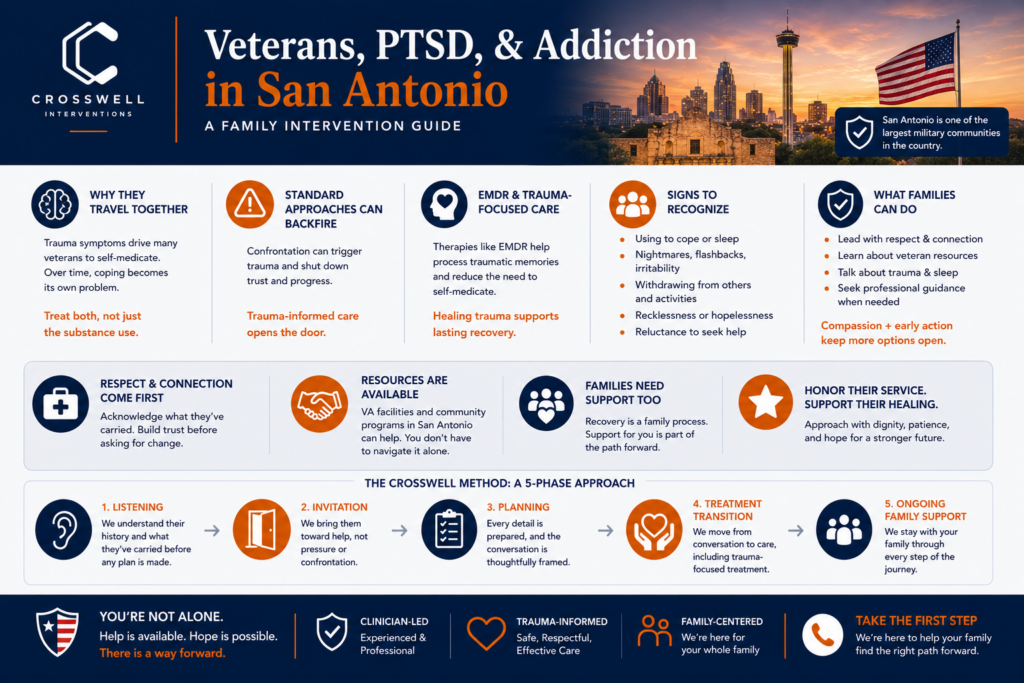
Post-traumatic stress and substance use disorders frequently co-occur, and the reasons are human rather than mysterious. When someone lives with hypervigilance, intrusive memories, disrupted sleep, chronic pain, or the emotional weight of things they cannot easily talk about, alcohol or other substances can start as a way to get through the night. It works, briefly, which is exactly why it takes hold. Over time the coping becomes its own problem, layered on top of the original wound.
For veterans, several threads can tangle together at once: combat exposure, physical injury and the pain that follows, the loss of the structure and identity that service provided, and the difficulty of asking for help in a culture that prizes self-reliance. None of this reflects weakness. It reflects the cost of what many service members carry, and it explains why treating the substance use alone often does not hold. If the trauma underneath is left unaddressed, the pressure to self-medicate does not go away.
Why standard approaches can backfire
A confrontational intervention, the kind still pictured in popular culture, can be especially counterproductive with someone carrying trauma. Being surrounded, cornered, or put on the spot can echo the very experiences that drive the hypervigilance in the first place. What reads as tough love to a family can register as threat to a nervous system that is already on alert.
A trauma-informed approach does the opposite. It lowers the sense of threat, moves at a pace the person can tolerate, and treats the substance use as a symptom to understand rather than a failing to punish. For veterans in particular, an approach that respects their experience and their autonomy is far more likely to earn a genuine yes. The distinction matters because a person pressured into treatment often leaves it, while a person who chooses it, even reluctantly, has something to hold onto when the work gets hard.
The role of EMDR and trauma-focused care
When trauma and addiction are entwined, the most durable results usually come from addressing both, rather than treating the substance use and hoping the trauma resolves on its own. Trauma-focused therapies, including EMDR, are designed to help the brain process traumatic memories so they lose some of their grip. As those memories become less overwhelming, the pull toward self-medication often eases.
This is central to how we work. Crosswell Interventions is led by an EMDR-trained clinician, and that background shapes our approach to families where trauma sits underneath the using. The goal is not simply to get a person to stop, but to help them build a life in which stopping is sustainable because the underlying pain is finally being treated.
Signs families should recognize
In a veteran or service member, these signs are worth noticing, especially in combination:
- Drinking or using to fall asleep, to quiet memories, or to manage anxiety
- Increasing tolerance, or needing more to get the same relief
- Nightmares, flashbacks, irritability, or being easily startled
- Withdrawing from family, friends, or the things that once mattered
- Recklessness, or a sense that they do not much care what happens to them
- Reluctance to seek help, framed as not wanting to be a burden or to appear weak
If you are seeing both a substance problem and signs of trauma, that overlap is the thing to take seriously. Treating one without the other rarely works for long. It is also worth remembering that families of veterans carry their own version of this strain, and that a spouse or parent running on years of worry and walking on eggshells is not a sign of failure but a sign of how heavy the situation has been.
What San Antonio families can do
Lead with respect and connection rather than ultimatum. Acknowledge what your loved one has carried instead of focusing only on the drinking or the using. Learn about the resources available to veterans, including care through the Department of Veterans Affairs and community programs, and be prepared for the possibility that your loved one may be more willing to accept help framed around trauma and sleep than help framed around addiction alone.
When a conversation is not enough, professional guidance matters even more here than usual, because the stakes of getting the approach wrong are higher. Our guides on why early intervention matters for mental health and substance use and on mental health interventions when it is not only about substances can help you think it through. For the broader local picture of the substances involved, our overview of fentanyl and meth in San Antonio provides context.
Why waiting is the wrong strategy
The instinct to wait, to give a veteran space, to hope they work it out on their own, is understandable and often comes from love. But trauma left untreated tends to deepen, and self-medication tends to escalate. Waiting for a crisis is especially risky when someone is already struggling with a sense that they do not much care what happens to them. Acting earlier, gently and with respect, keeps more options open for everyone.
A professional intervention is planned, supported, and compassionate, not an ambush. At Crosswell Interventions we use a five-phase approach, the Crosswell Method, adapted here with particular sensitivity to trauma and military culture:
- Listening. We start by understanding the person’s history and what they have carried, before any plan is made.
- Invitation. We bring the person toward help rather than cornering them, which matters even more when trauma is involved.
- Planning. Every practical and clinical detail is prepared in advance, including how to frame the conversation in a way that respects their experience.
- Treatment transition. We move from the conversation to actual care, matched to their needs, including trauma-focused treatment.
- Ongoing family support. Recovery is a family process, and families of veterans often carry their own strain that deserves support too.
How Crosswell Interventions helps San Antonio military families
We provide clinician-led, trauma-informed intervention and recovery support for families across Texas, including San Antonio’s large military community. Our EMDR-trained approach is built for exactly the situations where PTSD and substance use are tangled together. We help families approach a service member or veteran with respect, coordinate treatment that addresses both the trauma and the substance use, and stay with the family through what comes next.
Frequently Asked Questions
How is addiction different for veterans with PTSD? For many veterans, substance use begins as a way to manage trauma symptoms such as nightmares, hypervigilance, pain, or difficulty sleeping. Because the substance use is tied to the trauma, treating it in isolation often does not hold. Addressing both together tends to produce more durable results.
Can you treat PTSD and addiction at the same time? Yes, and for co-occurring PTSD and substance use, integrated care that addresses both is generally the recommended approach. Trauma-focused therapies such as EMDR can reduce the grip of traumatic memories, which in turn often eases the pull toward self-medication.
How do I approach a veteran without triggering their trauma? Lead with respect and connection rather than confrontation. Avoid cornering or surrounding them, acknowledge what they have carried, and consider framing help around trauma and sleep rather than around addiction alone. Professional, trauma-informed guidance can help you plan a conversation that lowers rather than raises the sense of threat.
What resources exist for veterans in San Antonio? San Antonio’s large military presence means there are VA facilities and community programs oriented toward veterans. A professional interventionist can help you navigate the options and coordinate care that fits your loved one’s specific needs, including trauma-focused treatment.
A final thought
Helping a veteran who is struggling is not about winning an argument. It is about making it safe enough for them to accept help for something they may have been carrying alone for a long time. In a city shaped by service, that work is both common and deeply personal. If you are watching someone you love and worrying, that worry is worth honoring, and there is a way forward that respects everything they have been through.
This is a sensitive topic. If you or a veteran you love is in crisis, support is available, including the Veterans Crisis Line, and you do not have to navigate it alone.
About the Author
Will Crosswell is a Licensed Clinical Social Worker (LCSW), Licensed Chemical Dependency Counselor (LCDC), and EMDR-trained clinician with more than ten years of experience helping families navigate addiction and mental health crises. His clinical training in trauma-informed care and family systems work informs the Crosswell Method’s approach to mental health intervention specifically. Crosswell Interventions is independent and does not accept referral fees from treatment facilities.