
San Antonio sits along some of the busiest drug corridors in the country, and that geography shapes what families here are up against. The story in Bexar County is not only about fentanyl. It is about fentanyl and methamphetamine together, often in the same supply and sometimes in the same product. If you are worried about someone you love in San Antonio, this article explains what the local picture looks like, what the seizures and data actually signal, and how a family can respond.
What the Bexar County picture shows
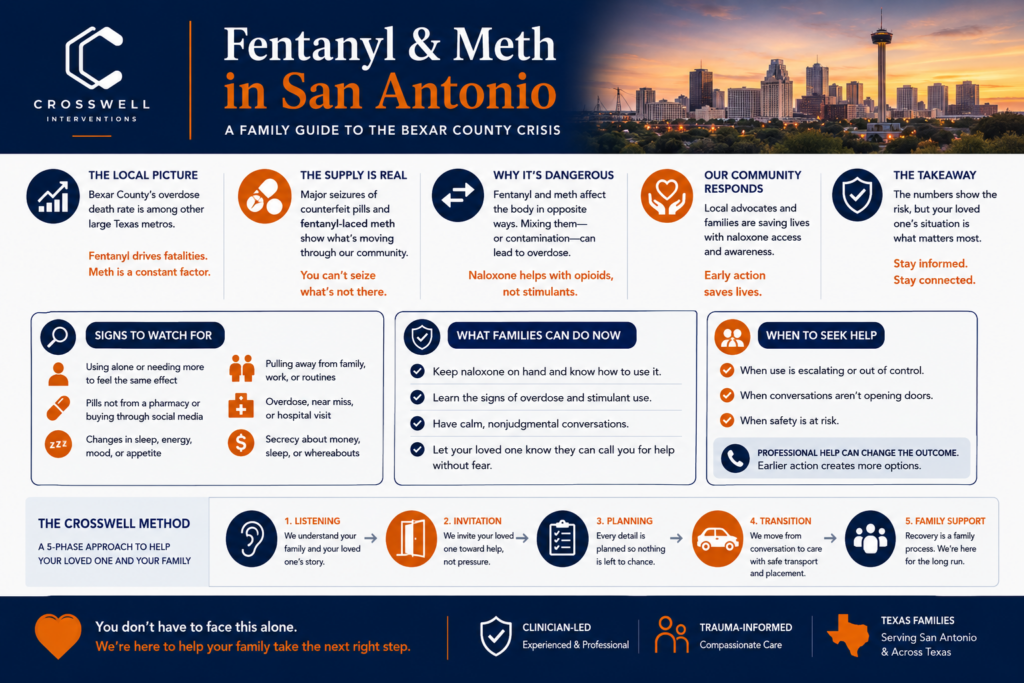
Bexar County’s overdose death rate has run in the same range as several other large Texas metros, near the low-to-mid twenties per 100,000 residents in recent reporting. Fentanyl drives much of the fatal risk, but methamphetamine is a constant presence, and the two increasingly travel together. That combination is part of what makes San Antonio’s situation distinct from a fentanyl-only narrative.
Local law enforcement seizures tell part of the story. Authorities in and around Bexar County have intercepted large quantities of counterfeit pills and multi-kilogram amounts of methamphetamine, some of it laced with fentanyl. It is important to read seizures correctly. A big bust is not only an enforcement win. It is also a measure of how much is moving through the region, because you cannot seize what is not there. For a family, the takeaway is that the local supply is substantial and unpredictable, and that no single purchase can be assumed to be safe or consistent.
Why the fentanyl and meth combination matters
Stimulants and opioids affect the body in opposite directions, and mixing them, whether on purpose or because the supply is contaminated, raises the danger in ways many families do not expect. A person who uses methamphetamine may have no intention of touching an opioid, yet fentanyl contamination can put them at risk of an opioid overdose anyway. Meanwhile, naloxone, the medication that reverses opioid overdoses, does nothing for the stimulant side of the equation.
This is why watching only for the signs of one kind of drug can leave a family a step behind. In San Antonio, the realistic assumption is that the supply is mixed, and that a loved one who uses any illicit substance may be exposed to fentanyl without knowing it. Methamphetamine also carries risks of its own that have nothing to do with opioids, including effects on the heart, on sleep, and on mental health over time. A stimulant problem is a serious problem in its own right, not a lesser one simply because it is not fentanyl.
The community response
San Antonio families have not been passive in the face of this. Local advocates, including parents who have lost children, have pushed naloxone into the community through free dispensers and awareness events. These efforts have saved lives, and they reflect a community that refuses to treat loss as inevitable. They also carry a quieter lesson for families still in the worry stage: the people who wish they had acted sooner are often the ones doing the most to help others act in time. If there is a single message that comes through from families who have been there, it is that waiting rarely made anything easier, and that reaching out earlier, even when it felt premature, is the choice they would repeat.
Signs families should recognize
Rather than watching the county number, watch the person. These are signs that risk may be rising:
- Using alone, or needing more of a substance to feel the same effect
- Taking pills that did not come from a pharmacy, or buying anything through social media
- Signs of stimulant use, including changes in sleep, appetite, agitation, or weight
- Pulling away from family, work, or daily routines
- A recent overdose, a near miss, or an unexplained hospital visit
- New secrecy about money, sleep, or where they have been
No single item proves anything. But if several appear together, that pattern matters far more for your family than any county statistic.
What San Antonio families can do right now
A few steps do not require anyone’s permission. Keep naloxone in the home and learn how to use it, since it is available across Bexar County through pharmacies, community organizations, and local advocacy groups, and it is safe to give even when you are not certain opioids are involved. Learn what use and overdose look like, including the signs of stimulant use, so you can respond rather than freeze. Then, when you are ready, start a calm conversation rather than a confrontation. The first talk does not need to solve anything. It needs to open a door, and leading with worry and love rather than accusation keeps that door open.
If you expect resistance, our guide on how to talk to someone who refuses help can help you prepare, and our overview of the signs it may be time for an intervention can help you judge timing. San Antonio is also home to a large military community, and when trauma sits underneath the using, that changes the approach entirely, which we cover in our guide on veterans, PTSD, and addiction in San Antonio.
When to step in, and why waiting is the wrong strategy
There is an old belief that a person has to hit rock bottom before help can work. It is not true, and with fentanyl in the San Antonio supply it can be fatal. Rock bottom, too often, is an overdose. Waiting for someone to lose everything does not make treatment more likely to succeed. It only removes chances along the way. We have written more about the real cost of waiting, and the core of it is simple: the earlier a family acts, the more options everyone keeps.
Acting early does not mean staging an ambush. A professional intervention is planned, supported, and compassionate. At Crosswell Interventions we use a five-phase approach, the Crosswell Method, built around connection rather than pressure:
- Listening. We start by understanding the family system and the person’s story before any plan is made.
- Invitation. We bring the person toward help rather than cornering them, so the conversation feels like an open door instead of a trap.
- Planning. Every practical and clinical detail is prepared in advance, so nothing is left to chance when emotions run high.
- Treatment transition. We move from the conversation to actual care, including safe transport and placement, closing the gap where good intentions often fall apart.
- Ongoing family support. Recovery is a family process, not a single day, so the work continues after treatment begins.
When to step in, and why waiting is the wrong strategy
We provide clinician-led intervention support in San Antonio and across Texas, from the first worried phone call through treatment placement and family coaching. Our work is trauma-informed and family-centered, and our goal is to help families act on a clear read of their own situation rather than on a headline. We coordinate the details so the distance between deciding to help and actually getting a loved one into care does not become the place where everything stalls.
Frequently Asked Questions
How common is fentanyl in San Antonio? Fentanyl is a leading driver of overdose deaths in Bexar County, and it increasingly shows up alongside methamphetamine. Large local seizures of counterfeit pills and fentanyl-laced meth indicate a substantial and unpredictable supply moving through the region.
Is meth in San Antonio laced with fentanyl? It can be. Authorities have seized methamphetamine laced with fentanyl in the area, and contamination is not always visible or intentional. Someone who uses only stimulants can still be exposed to fentanyl and at risk of an opioid overdose.
Can naloxone help with a meth overdose? Naloxone reverses opioid overdoses, so it can help if fentanyl is involved, which is a real possibility given contamination. It does nothing for the stimulant effects of methamphetamine on its own. It is still worth keeping on hand, because the supply is so often mixed.
Where can San Antonio families get naloxone? Naloxone is available across Bexar County through pharmacies, community organizations, and local advocacy groups that distribute it free, along with the state’s naloxone locator resources. It is safe to carry and administer and can turn a fatal night into a survivable one.
A final thought
San Antonio’s challenge is a mixed and unpredictable supply, and behind the seizures and the statistics are families who did not expect to be part of this. But a county figure describes a population, not a promise to any one household. If you are watching someone you love and feeling that quiet, persistent worry, that feeling is more reliable than any chart. The direction of Bexar County’s numbers does not change what your own eyes are telling you, and it does not have to set the timeline for what you do next.
About the Author
Will Crosswell is a Licensed Clinical Social Worker (LCSW), Licensed Chemical Dependency Counselor (LCDC), and EMDR-trained clinician with more than ten years of experience helping families navigate addiction and mental health crises. His clinical training in trauma-informed care and family systems work informs the Crosswell Method’s approach to mental health intervention specifically. Crosswell Interventions is independent and does not accept referral fees from treatment facilities.