Dallas-Fort Worth is not one place. It is a sprawling metroplex of counties that each experience the fentanyl crisis a little differently, and a single regional headline can hide as much as it reveals. If your family lives somewhere in North Texas and you are trying to understand the risk around you, it helps to see how the pieces fit together. This article lays out the regional picture and what it means for families deciding whether and when to act.
Fentanyl does not respect county lines
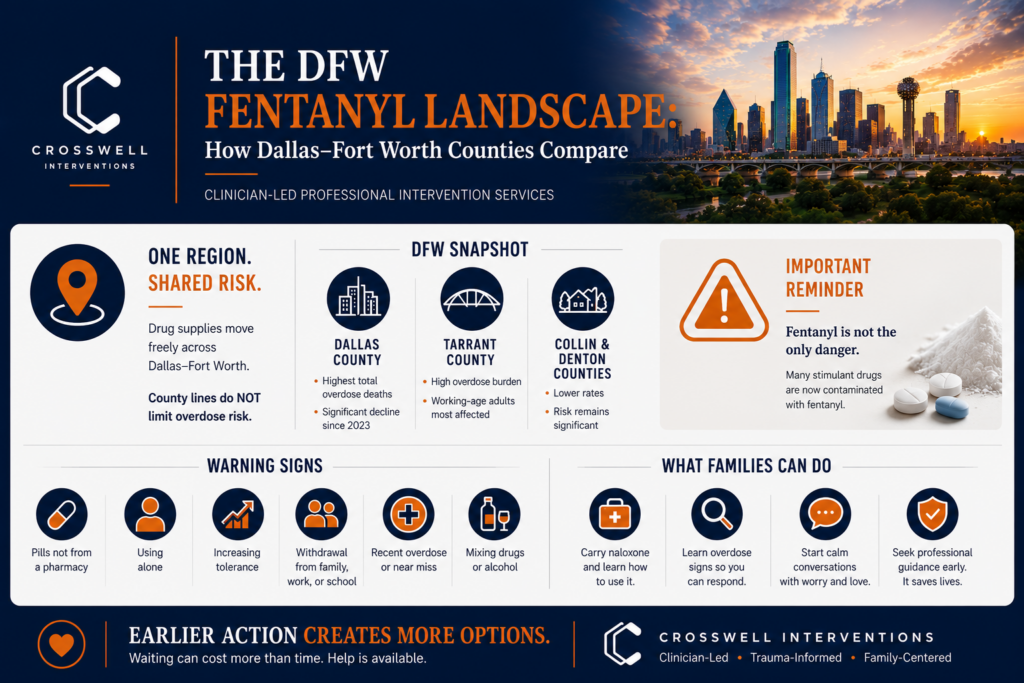
The most important thing to understand about the metroplex is that the drug supply moves freely across it. Someone may live in Denton, work in Dallas, and buy pills that originated somewhere else entirely. That is part of why regional bodies track the problem at a scale larger than any single city. The North Texas High Intensity Drug Trafficking Area program produces annual threat assessments precisely because supply and demand cross jurisdictions, and coordinated efforts, including a regional overdose response effort that expanded across multiple cities in late 2025, exist for the same reason.
For a family, the practical takeaway is simple. The trend in your specific county is useful information, but it does not fence in your risk. What a loved one is using, and where they get it, matters more than which suburb you happen to live in.
How the counties compare
Across the broader North Texas public health region, fentanyl came to dominate opioid deaths, rising to roughly 80 percent of them by 2023. Underneath that regional figure, the counties differ.
Dallas County carries the largest totals in the metroplex and saw a steep rise followed by a significant decline, with fentanyl deaths falling from about 282 in 2023 to roughly 140 by late 2024. Its per-capita death rate sat around 25 per 100,000 in 2023. Tarrant County, anchored by Fort Worth, recorded about 185 fentanyl-related deaths in 2023, with a rate near 23 per 100,000, and its overdoses have fallen most heavily on men and on working-age adults. The fast-growing suburban counties, including Collin and Denton, tend to show lower per-capita rates than the urban core, but “lower” is not “low,” and the counterfeit-pill deaths that shook several North Texas suburbs are a reminder that no community is exempt.
The pattern that emerges is not a single number but a gradient. The urban core carries higher totals and rates, the suburbs carry real and rising risk, and the supply that drives all of it is shared.
Fentanyl is also not the only concern across the region. Methamphetamine and cocaine remain common throughout North Texas, and stimulants are increasingly contaminated with fentanyl. That matters for how families read risk, because someone who believes they only use a stimulant can still die from an opioid overdose without ever intending to touch one. Watching only for the signs of opioid use can leave a family a step behind what is actually happening.
What the regional view reveals for families
Reading the metroplex as one connected system changes how a family thinks about help. It means that treatment and intervention often need to cross county lines too. A family in one county may place a loved one in a program in another, arrange transport across the region, and coordinate care among providers who are not all in the same place. That coordination is not a complication to be feared. It is simply part of how help works in a region this large, and it is manageable with the right support.
It also means the emotional experience of families across DFW is more similar than the county-by-county data suggests. The worry, the second-guessing, and the question of when to step in look much the same in Frisco as they do in south Dallas. A family should not assume that living in a lower-rate county means the danger is lower for their particular loved one, and a family in a higher-rate county should not assume the situation is hopeless. The county figure is context, not destiny.
Signs families should recognize
Wherever you live in the metroplex, watch the person rather than the county figure. These are signs that risk may be rising:
- Taking pills that did not come from a pharmacy, or buying anything through social media
- Using alone, or needing more of a substance to feel the same effect
- Pulling away from family, work, school, or daily routines
- A recent overdose, a near miss, or an unexplained hospital visit
- Mixing substances, or mixing substances with alcohol
- New secrecy about money, sleep, or where they have been
What DFW families can do right now
A few steps do not require anyone’s permission. Keep naloxone in the home and learn how to use it, since it is widely available across the metroplex and safe to give even when you are not certain opioids are involved. Learn what use and overdose look like, so you can respond rather than freeze. Then, when you are ready, start a calm conversation rather than a confrontation. The first talk does not need to solve anything; it needs to open a door, and leading with worry and love rather than accusation keeps that door open.
If you want to understand your own county more closely, our look at fentanyl in Dallas County goes deeper on the urban core. For preparing the conversation itself, our guides on the signs it may be time for an intervention and how to talk to someone who refuses help are good starting points.
When to step in, and why waiting is the wrong strategy
There is an old belief that a person has to hit rock bottom before help can work. It is not true, and with fentanyl moving freely across the metroplex it can be fatal. Waiting for someone to lose everything does not make treatment more likely to succeed. It only removes chances along the way. We have written more about the real cost of waiting, and the core of it is simple: the earlier a family acts, the more options everyone keeps.
A professional intervention is planned, supported, and compassionate, not an ambush. At Crosswell Interventions we use a five-phase approach, the Crosswell Method, built around connection rather than pressure:
- Listening. We start by understanding the family system and the person’s story before any plan is made.
- Invitation. We bring the person toward help rather than cornering them.
- Planning. Every practical and clinical detail is prepared in advance, which matters especially when a family and a program sit in different counties.
- Treatment transition. We move from the conversation to actual care, including safe transport and placement across the region.
- Ongoing family support. Recovery is a family process, not a single day.
How Crosswell Interventions helps DFW families
We provide clinician-led professional intervention services in Dallas and throughout the Dallas-Fort Worth metroplex, from the first worried phone call through treatment placement and family coaching. Because the region spans so many counties, much of our work is coordination: aligning the family, the conversation, transport, and the right program, even when they are not all in the same place. Our approach is trauma-informed and family-centered.
Frequently Asked Questions
Which DFW county has the most overdose deaths? Dallas County carries the largest totals in the metroplex, which is expected given its size, and it also saw a significant decline after a steep rise. Tarrant County recorded a substantial number as well. Per-capita rates vary, with the urban core generally higher than the suburbs, but risk exists throughout the region.
Is fentanyl worse in Dallas or Fort Worth? Both counties have been hit hard, and comparing them by a single number is less useful than it sounds. The supply is shared across the metroplex, so the more important question for a family is what a specific person is using and where they get it, not which county line they live on.
How do families get help if they live between counties? This is common in DFW and entirely workable. A professional interventionist can coordinate planning, the conversation, transport, and placement across county lines, so living in a different county from a treatment program does not become a reason to delay.
Are the suburbs safer than the urban core? Suburban counties often show lower per-capita rates, but counterfeit pills have caused deaths in several North Texas suburbs, including among teenagers. Lower risk is not no risk, and no community is exempt.
A final thought
The metroplex is large, and its counties do not experience fentanyl in exactly the same way. But the supply is shared, the worry is shared, and the path forward is shared too. A regional figure describes a population, not a promise to any one family. If you are watching someone you love and feeling that quiet, persistent worry, that feeling is more reliable than any map. Where you live in DFW does not change what your own eyes are telling you.
About the Author
Will Crosswell is a Licensed Clinical Social Worker (LCSW), Licensed Chemical Dependency Counselor (LCDC), and EMDR-trained clinician with more than ten years of experience helping families navigate addiction and mental health crises. His clinical training in trauma-informed care and family systems work informs the Crosswell Method’s approach to mental health intervention specifically. Crosswell Interventions is independent and does not accept referral fees from treatment facilities.