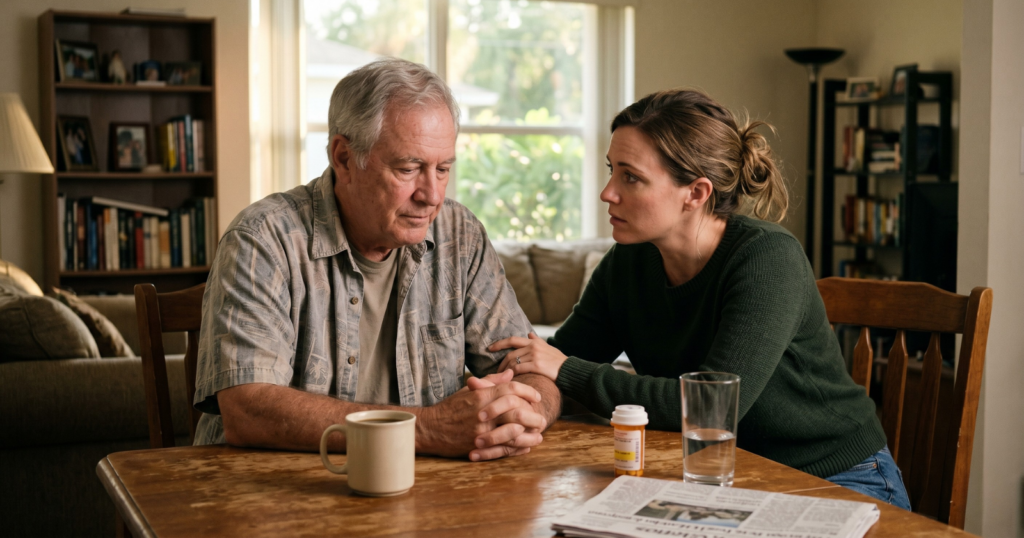
The call usually comes from up north.
The parents retired to Sarasota, or Naples, or Vero Beach, or The Villages, or any of a hundred coastal and inland Florida towns where the winters are mild and the medical care is decent and the grandkids visit at spring break. The adult children are in Connecticut, or Ohio, or Massachusetts, or Michigan, or Virginia. The yearly rhythm goes like this: the daughter visits at Thanksgiving and notices her father seems tired. The son visits in February and notices the wine bottles have gotten taller. By the following Thanksgiving, the daughter notices her father is sleeping during the day, has fallen twice in the past month, and his physician, who he hasn’t seen in nine months, doesn’t know about either fall.
This is one half of Florida’s quiet addiction crisis. The other half is the year-round Florida resident, often younger, dealing with patterns more familiar from national headlines (fentanyl, cocaine, alcohol, methamphetamine) in a state with one of the largest treatment industries in the country, which paradoxically can make finding the right help harder rather than easier.
Florida is a complicated geography for addiction in ways most articles don’t address honestly. This guide tries to.
Florida's Addiction Reality, By the Numbers
The Florida Department of Health maintains overdose surveillance data, and the patterns over the past several years have been consistent: fentanyl drives most opioid-related deaths, cocaine has resurged particularly in South Florida, methamphetamine has spread inland, and alcohol-related deaths, especially among older adults, have been climbing in ways that don’t make headlines but that the clinical data confirms.
The regional patterns within Florida differ meaningfully:
Miami-Dade and Broward Counties have rising cocaine deaths, frequently with fentanyl contamination. The South Florida cocaine supply, historically distinct from other regional supplies, has begun showing the contamination patterns seen elsewhere in the country. Counterfeit pills are widely distributed. The nightlife economy in Miami Beach, Fort Lauderdale, and Wynwood overlays substance access onto a tourism-and-hospitality industry that runs around the clock.
Orlando and Central Florida have a mixed picture: the tourism industry layer, the residential family layer, and a substantial young-adult population at the area’s colleges and theme park employer base. Opioid involvement in overdose deaths is high. The cluster of treatment facilities in the region (Central Florida has one of the highest concentrations of addiction treatment programs in the country) means more visibility into the crisis but also more saturation in the family-facing market.
Tampa Bay has its own pattern, with concentrated overdose burden in certain neighborhoods and a substantial population of working-age adults whose use developed during the prescription-opioid era and transitioned to street opioids.
Jacksonville and Northeast Florida show patterns more consistent with the broader Southeast region (opioids, methamphetamine, and a significant military-and-veteran population dimension given the area’s Naval bases).
The Panhandle has its own distinct picture, closer to the Gulf South opioid and methamphetamine patterns than to the South Florida cocaine-and-fentanyl pattern.
Retirement communities (which exist throughout Florida but cluster particularly along both coasts) carry the alcohol-and-prescription-medication pattern that often goes unrecognized.
For Orlando-area families specifically, intervention support in Orlando addresses the regional dynamics directly. For Miami-area cases, families navigating addiction in Miami work with attention to South Florida’s specific supply and treatment landscape.
The Snowbird Family Problem
One of the most consistent patterns in our Florida work is the adult-child-up-north / aging-parent-in-Florida configuration. It produces a specific kind of slow crisis that is well-known to many families and poorly addressed by most addiction literature.
The general shape:
The parent retired to Florida five, ten, fifteen years ago. Retirement was earned. The early years were good: golf, friends, the community pool, the new identity. Then the slow erosion began. A spouse died, or a close friend died, or the friend group started thinning. Health became more central than activity. The drinks before dinner became drinks during dinner became drinks instead of dinner.
The adult children, six hundred or fifteen hundred miles away, see snapshots. The Thanksgiving snapshot. The February snapshot. The summer visit when the parents come north. The video calls.
What gets missed in the snapshots:
- The day-to-day weight loss that compounds slowly enough that no single visit catches it
- The medication interactions that develop as new prescriptions are added on top of existing alcohol use
- The balance problems that get attributed to “getting older” but are actually combined alcohol-and-medication effects
- The memory issues that look like normal aging but are deepened by chronic alcohol exposure
- The social withdrawal that gets explained as “they’re slowing down” but is actually depression and isolation
- The financial irregularities that nobody notices because the parents handled their own finances and “we don’t want to be invasive”
When the picture finally comes into focus, usually because a fall, a medical event, a missed payment, or a clearer conversation with a parent’s neighbor, the family realizes the situation has been advancing for years.
This pattern is not rare. The National Institute on Alcohol Abuse and Alcoholism reports that older adults are increasingly affected by alcohol use disorder, and Florida (with its concentration of retirees, its mild climate that supports outdoor drinking culture year-round, and its physical distance from most adult-children-of-retirees) sees it at higher density than perhaps any other state.
The clinical framing matters here. Older-adult alcohol use disorder is not the same as younger-adult alcohol use disorder, and it requires a different intervention approach. The shame floor is different. The identity-and-life-stage context is different. The medical complications are different. The treatment landscape is different.
Florida's Recovery Industry and Why That Matters
Florida has more residential addiction treatment programs per capita than nearly any other state. This is partly because of the climate, partly because of historic regulatory factors, partly because of the state’s long association with recovery communities, and partly because the treatment industry consolidated heavily in Florida during the prescription-opioid era.
This is, for families, both a strength and a complication.
The strength: there are good treatment programs in Florida, in essentially every modality, including residential, intensive outpatient, partial hospitalization, dual-diagnosis specialty, eating disorder specialty, trauma specialty, and many others. Treatment options exist in volume.
The complication: the volume of programs has produced a saturated market, and not all programs operate at the same clinical standard. Marketing budgets are substantial. Some programs have referral-fee arrangements with interventionists, family advocates, and “treatment placement specialists” that introduce financial incentives into recommendations that should be clinical. The patient-brokering scandals that produced federal investigations and state-level reforms in the past decade have left a legacy of caution that is well-founded.
For families navigating this landscape, the key is to work with professionals who are genuinely independent of facilities. The Crosswell stance is direct: we do not own treatment facilities, we are not affiliated with any treatment facility, and we accept no referral fees from facilities. Our recommendations are based on clinical fit for the specific case. This matters more in Florida than in some other states, given the saturated and historically problematic market dynamics. Families can also independently verify provider licensure through the Florida Department of Children and Families substance abuse provider directory.
For families considering a professional interventionist serving Florida families, we encourage you to ask any interventionist directly about their financial arrangements with treatment facilities. The honest answer matters.
Recognizing Addiction in Older Adults
The signs of alcohol use disorder in older adults are often attributed to age, medication side effects, or “just slowing down.” They are real signs of something more specific.
Physical patterns specific to older-adult alcohol use:
- Balance issues, increased falls, or unsteadiness
- Memory issues that progress faster than would be expected from typical aging
- Sleep disruption, including both insomnia and excessive sleeping
- Weight loss without clear medical explanation
- Skin changes, particularly facial flushing or rosacea-like patterns
- Bruising in unexpected locations (often from minor falls the person doesn’t mention)
- Gastrointestinal issues that the person attributes to “not feeling well lately”
- Hypertension that doesn’t respond to medication adjustments
- Liver enzyme elevations on routine bloodwork
Behavioral patterns:
- Increasing reluctance to drive, particularly in the evening
- Avoiding activities or events that previously brought joy
- Drinks earlier in the day than they used to
- “Cocktail hour” extending or starting earlier
- Hidden bottles, or bottles in unusual places
- Defensiveness when alcohol use is mentioned
- “I’ve earned this” or “I’m too old to change” responses
- Withdrawal from family events or visits
The medication interaction problem:
Older adults typically take multiple prescription medications. Alcohol interacts with nearly all of them in clinically significant ways. According to National Institute on Aging guidance on alcohol use in older adults, common interactions include:
- Anticoagulants (blood thinners) + alcohol = increased bleeding risk
- Diabetes medications + alcohol = blood sugar instability
- Hypertension medications + alcohol = unpredictable blood pressure
- Anti-anxiety medications (especially benzodiazepines) + alcohol = severe sedation, fall risk, respiratory depression
- Pain medications (including over-the-counter NSAIDs) + alcohol = GI bleeding, liver damage
- Sleep medications + alcohol = severe sedation and respiratory effects
A parent who is drinking more than is healthy and also taking multiple prescriptions is in a different medical situation than a younger adult drinking the same amount.
The loss-and-identity dimension:
Older-adult substance use frequently emerges around losses: of spouses, of close friends, of physical capacity, of work identity, of social role. The clinical literature on older-adult substance use disorder consistently points to grief, isolation, and identity disruption as the most reliable precipitants.
This matters for intervention design. The “consequences” framing that sometimes works in younger-adult substance interventions almost always backfires with older adults. A seventy-year-old who has been through significant losses does not respond well to a framing of “here’s what continues to happen if you don’t accept help.” They have already had many things happen. The framing that works is closer to reconnection (to relationships, to purpose, to a sense of forward life) paired with addressing the medical reality directly. For cases involving alcohol specifically, alcohol-specific intervention services in Florida follow this clinical approach.
Recognizing Addiction in Younger Florida Locals
For Florida residents who are not retirees (adult children of Florida natives, young professionals, hospitality workers, college students, military and veteran populations), the patterns are more familiar from national addiction discourse.
Fentanyl and counterfeit pills. Widely available across Florida, particularly in counterfeit forms (pressed pills that look like prescription medications). Young adults in particular often have their first exposure through “pills from friends” that they assume are pharmaceutical.
Cocaine, particularly in South Florida. The nightlife and hospitality industries in Miami Beach, Fort Lauderdale, Wynwood, Tampa, and Orlando carry substantial cocaine use. Increasingly, this cocaine is contaminated with fentanyl.
Methamphetamine, particularly inland and in working-class communities. Florida has seen significant methamphetamine spread in the past decade, with patterns that increasingly mirror those of Western states.
Alcohol, normalized by the year-round outdoor and beach culture. Florida’s drinking culture is intense and continuous in a way that makes problematic patterns harder to identify.
Cannabis, with rising potency and frequency patterns that increasingly produce clinical concerns particularly in young adults.
The signs for these populations are the standard substance use disorder indicators that broader addiction literature addresses well.
The recovery community insider dimension deserves a specific note. Florida has thousands of people who came for treatment, stayed for recovery, and built lives in the state’s substantial recovery community. When someone in this population relapses, the dynamics are particular: there is often deep shame, often hesitation to re-engage with treatment because of previous experience, and often a strong recovery network that has noticed before the family has. Intervention work in this population is its own subspecialty.
Staging an Intervention from Out of State
For the snowbird-family configuration, the logistics of intervention follow a specific pattern:
Travel coordination. Family members typically fly in either the day before the intervention or the morning of, depending on the family’s geography and the parent’s schedule. Pre-intervention rehearsal happens either remotely beforehand or in person upon arrival.
Choosing the setting. Most older-adult interventions happen in the parents’ Florida home, because that is the natural environment and any other setting would itself be a signal that something unusual is happening. The home setting requires careful planning: who is present, what time of day, what the loved one has eaten and consumed in the hours before.
Timing windows. Many families use the holiday visit as the natural intervention occasion. Thanksgiving, Christmas, the spring visit, the summer trip: these provide natural reasons for the family to be in Florida together without raising suspicion. This timing is not deceptive; it is logistical.
The pre-intervention family work. Most of the work happens before the family arrives in Florida. Multiple remote sessions with the family across whatever geographies they live in. Mapping the family system. Understanding the parents’ history and the development of the use pattern. Planning the conversation, the language, the sequencing, the responses to anticipated objections.
Sober transport from Florida. Many older-adult cases involve out-of-state treatment placement, often for specialized care or for geographic separation from the home environment that has been organized around use. Sober transport from Florida to treatment, frequently involving air travel, is part of the planning.
Treatment Decisions: Stay in Florida or Leave?
This is one of the most common family questions in Florida cases.
Arguments for Florida-based treatment: The parents are already established in Florida, the climate is conducive to recovery, the state has a substantial recovery community, family visits during treatment are easier if the family is already in Florida for periodic visits.
Arguments for out-of-state treatment: Geographic separation from the home environment, distance from any drinking-buddy or use-related social network in their Florida community, access to specialized programs (eating disorder specialty, dual diagnosis specialty, trauma specialty) that may not be locally available, removal from a Florida cultural environment that may have normalized the use, and the family being more involved in care if treatment is closer to where the family lives.
For many snowbird-family cases, an out-of-state placement closer to the adult children, followed by careful planning of the return to Florida, works clinically better than in-state placement. The decision is case-by-case. The federal SAMHSA Behavioral Health Treatment Services Locator can help families compare licensed options across both Florida and other states.
The Crosswell approach to treatment placement coordination is integrated with the intervention work. We do not finish the family meeting and hand the family a list of facilities to research on their own. The placement is identified, vetted, and confirmed before the intervention occurs. The treatment program is part of the plan, not an afterthought.
Frequently Asked Questions
Can you intervene on a parent who’s an alcoholic in their 70s?
Yes. Older-adult interventions are a significant part of our practice. The clinical approach differs from younger-adult interventions (the shame frame, the identity context, the medical considerations, and the family-system dynamics all require specific handling), but the work is the same in structure.
Does Crosswell work in all parts of Florida (Miami, Orlando, Tampa, Jacksonville)?
Yes. We work statewide and have experience across all the major regions. The specific logistics vary by location but the model is consistent.
What if my parent says they “earned” the right to drink after working their whole life?
This is one of the most common responses, and it deserves a direct answer. The earned-the-right framing is real and respected. It is not dismissed. The clinical reality is also real: the medical, cognitive, and relational costs of advanced alcohol use disorder in older adults are not the freedom-to-enjoy-retirement the framing suggests they are. The intervention conversation acknowledges the legitimate desire for autonomy in later life while introducing accurate information about what is actually happening medically and relationally. This is not a hostile conversation. It is a clarifying one.
How do we coordinate from up north?
Most of the pre-intervention work happens remotely. Multiple sessions with the family across whatever states you are spread across. The in-person component is the intervention itself and the immediate transition to treatment. We have built the model around the coordination challenge.
What about Medicare coverage for treatment?
Medicare coverage of addiction and mental health treatment has improved significantly in recent years, but the specifics vary by program, facility, and individual coverage. We discuss the general picture with families and refer specific coverage questions to the treatment programs and to Medicare directly. We do not give specific insurance advice.
Can you provide sober transport from Florida to a treatment center in another state?
Yes. Sober transport from Florida, including to airports and across state lines, is part of our service. For older adults with medical complexity, the transport coordination includes attention to medication management, medical needs in transit, and clinical handoff to the receiving facility.
Should the whole family fly down or just key members?
Case by case. The Planning phase determines who should be present at the intervention and who should not be. More people is not always better; the right people in the right configuration matters more than the total number. We work this through with the family in advance.
Conclusion
Florida’s addiction landscape is shaped by its size, its climate, its retirement demographics, its tourism economy, and its substantial treatment industry. For families navigating addiction in Florida, whether they are full-time residents or coordinating into the state from elsewhere, the right next step is rarely obvious from a distance.
The most useful first action is a single conversation with a clinician who can give you a clear-eyed assessment of where you are. The conversation is confidential, it does not commit you to anything, and it provides a starting point for understanding what timing and structure look like in your specific case.
We work with Florida families directly, with families coordinating into Florida from other states, and with families across the country navigating similar dynamics.
About the Author
Will Crosswell is a Licensed Clinical Social Worker (LCSW), Licensed Chemical Dependency Counselor (LCDC), and EMDR-trained clinician with more than ten years of experience helping families navigate addiction and mental health crises. Crosswell Interventions is independent and does not accept referral fees from treatment facilities, operating as an advocate for the families it serves rather than for any treatment program.