Fentanyl and meth get the headlines, and for good reason. But in Fort Worth, as everywhere, the most common and most normalized addiction is still alcohol, and it quietly harms more families than any illicit drug. It rarely arrives with the shock of an overdose. It escalates quietly, over years, hidden in plain sight at every dinner, every celebration, every backyard barbecue, and every ordinary evening at home. That very ordinariness is what makes it so easy for families to wait too long, and to mistake a genuine addiction for a personality trait or a bad habit that will sort itself out. This article is about recognizing when love and patience, as real as they are, are no longer enough, and what a family can do next.
Why alcohol is uniquely hard to confront
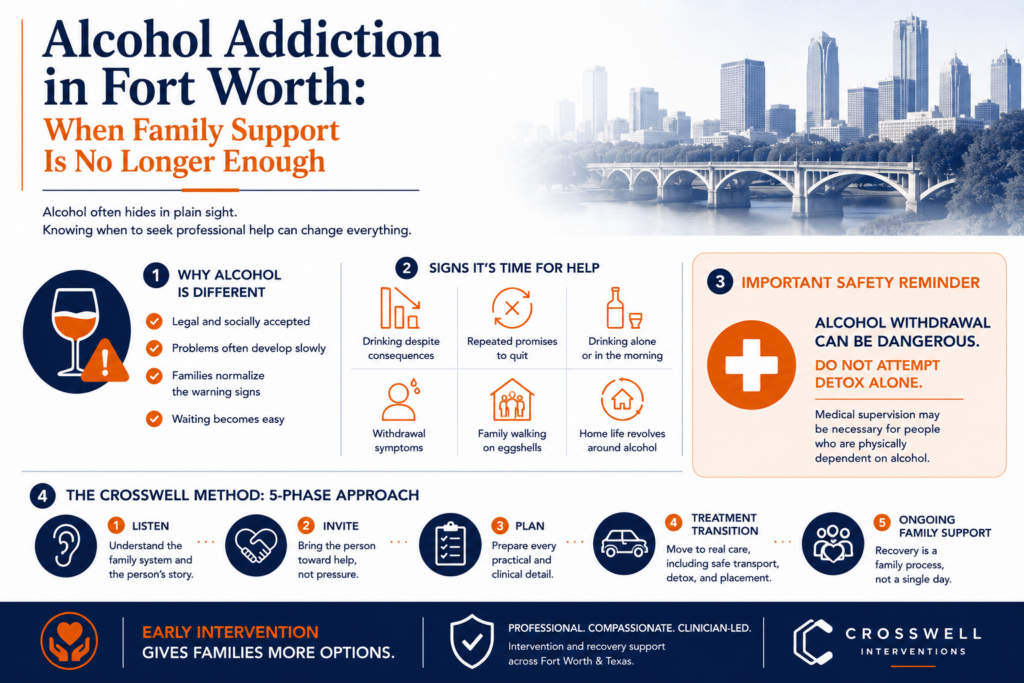
Almost every hard conversation about alcohol runs into the same wall: it is legal, it is everywhere, and everyone drinks. When a substance is woven into the culture this thoroughly, a family can spend years explaining away what they see. He just likes to unwind. She has had a stressful year. It is only beer. Everyone drinks at the game. Each explanation is individually reasonable, and together they can delay action long past the point where it was needed. Culture does much of the work of hiding the problem, because a behavior that would raise immediate alarm with any other substance passes as ordinary, even sociable, when the substance is alcohol.
Alcohol also escalates slowly, which hides the trajectory. Unlike a drug that can kill on first exposure, alcohol use disorder tends to deepen by degrees, so the family keeps recalibrating what counts as normal. By the time the problem is undeniable, it may have been building for a decade, and the person may not see it as a problem at all, because in their circle it looks like everyone else.
The medical reality families should understand
There is one fact about alcohol that sets it apart from many other substances, and every family should know it: for someone who is physically dependent, suddenly stopping can be medically dangerous. Alcohol withdrawal is not simply uncomfortable. In serious cases it can involve severe complications that require medical care. This is not a reason to keep someone drinking. It is a reason not to attempt detox alone, and to make sure that stopping happens with appropriate medical oversight.
We mention this not to alarm you, but because well-meaning families sometimes push a loved one to quit cold turkey without realizing there can be real medical risk. Professional guidance ensures that the path to sobriety is also a safe one.
It also helps to understand why the drinking took hold in the first place. For many people, alcohol is doing a job: quieting anxiety, dulling depression, numbing grief, or softening the edges of trauma. When that is the case, telling someone to simply stop removes their coping tool without addressing what they were coping with. Durable recovery usually means treating the underlying pain alongside the drinking, which is one reason a clinical, trauma-informed approach tends to hold better than willpower and ultimatums.
Signs family support has reached its limit
Families are remarkably good at absorbing a drinking problem: covering for it, managing around it, cleaning up after it, and hoping. These are signs the situation has outgrown what family support alone can carry:
- Drinking that continues despite clear harm to health, work, or relationships
- Failed promises to cut back, repeated and sincere but not sustained
- The family reorganizing life around the drinking, walking on eggshells, or hiding it from others
- Withdrawal symptoms when not drinking, such as shakiness, sweating, or agitation
- Drinking in the morning, drinking alone, or needing more to feel the same effect
- The emotional toll spreading to children, partners, or the person’s own sense of self
None of these mean a family has failed. They mean the problem has reached a scale that love, on its own, was never equipped to solve.
The toll rarely stays contained to the person drinking. Partners often carry a low, constant vigilance, managing moods and hiding the situation from friends and extended family. Children in the home absorb more than adults tend to realize, learning to read the signs of a hard night and to keep the peace. Part of why professional help matters is that it addresses the whole family system, not only the person with the glass in their hand. Recovery, when it comes, is something the family does together, and the family often needs its own support to heal.
How a compassionate alcohol intervention works
An intervention for alcohol is not the confrontational scene people picture. Because the person may genuinely not see their drinking as an addiction, an accusatory approach tends to trigger defensiveness and denial. A trauma-informed, non-confrontational approach works far better. At Crosswell Interventions we use a five-phase approach, the Crosswell Method, built around connection rather than pressure:
- Listening. We start by understanding the family system and the person’s story before any plan is made.
- Invitation. We bring the person toward help rather than cornering them, so the conversation feels like an open door instead of a trap.
- Planning. Every practical and clinical detail is prepared in advance, including how to manage withdrawal safely.
- Treatment transition. We move from the conversation to actual care, including medically supervised detox where appropriate, safe transport, and placement.
- Ongoing family support. Recovery is a family process, not a single day, so the work continues after treatment begins.
Waiting for a drinker to hit rock bottom is a particularly costly strategy, because alcohol does its damage slowly and cumulatively, to the liver, the heart, the brain, and the family, long before any single dramatic bottom arrives. We have written more about the real cost of waiting, and about the signs it may be time for an intervention.
How Crosswell Interventions helps Fort Worth families
We provide clinician-led intervention and recovery support across Texas, including the Fort Worth area, from the first worried phone call through treatment placement and family coaching. For alcohol in particular, we help families act before a crisis and ensure that stopping happens safely, with medical oversight where it is needed. Our approach is trauma-informed and family-centered. Because alcohol-related harm is rising across the state, our statewide overview of why alcohol-related deaths are rising in Texas offers useful context, and families dealing with the same issue in the Houston area may find our piece on alcohol interventionist support in Houston helpful as well.
Frequently Asked Questions
How do I know if my spouse’s drinking is an addiction? Warning signs include drinking that continues despite clear harm, repeated failed attempts to cut back, needing more to feel the same effect, drinking alone or in the morning, and withdrawal symptoms when not drinking. If your family has reorganized life around the drinking, that alone is a strong signal worth taking seriously.
Is it dangerous to quit alcohol suddenly? It can be. For someone who is physically dependent, stopping abruptly can cause serious withdrawal complications that require medical care. This is why detox from alcohol should happen with appropriate medical oversight rather than alone at home.
Can you stage an intervention for alcohol, not just drugs? Yes. Alcohol interventions are common and effective. Because a person may not see their drinking as a problem, a calm, non-confrontational, professionally guided approach tends to work far better than an ultimatum.
What if my loved one insists everyone drinks like they do? This is common, because alcohol is so normalized that a person can genuinely believe their drinking is ordinary. Rather than arguing about definitions, focus on specific harms you have observed, and consider professional guidance to help frame the conversation in a way that lowers defensiveness.
A final thought
Alcohol is the addiction families most often live alongside for years before naming it, precisely because it hides so well inside normal life. Loving someone through a drinking problem is not the same as being able to fix it, and reaching the limit of what family support can do is not a failure. It is often the moment real help becomes possible. Bringing in professional support does not mean giving up on your loved one. It usually means the opposite: taking the problem seriously enough to stop managing it alone and start addressing it in a way that can actually work. If you are watching someone you love and quietly worrying, that worry has usually been right for longer than you have let yourself admit. Trusting it, and reaching out before a crisis forces the issue, is not an overreaction. It is often the first genuinely helpful step a family takes.
This is a sensitive topic. If you or a loved one is struggling, support is available, and you do not have to navigate it alone.
About the Author
Will Crosswell is a Licensed Clinical Social Worker (LCSW), Licensed Chemical Dependency Counselor (LCDC), and EMDR-trained clinician with more than ten years of experience helping families navigate addiction and mental health crises. His clinical training in trauma-informed care and family systems work informs the Crosswell Method’s approach to mental health intervention specifically. Crosswell Interventions is independent and does not accept referral fees from treatment facilities.