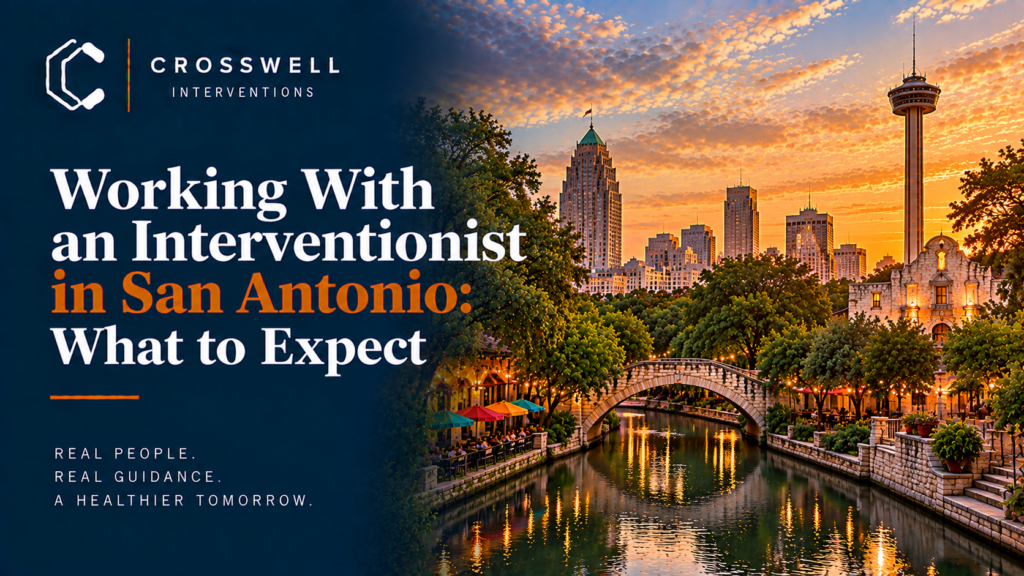
If you are considering an interventionist, you are probably somewhere between two feelings: this cannot continue, and it feels like a drastic step.
Both are reasonable. This article covers what actually happens when a San Antonio family hires an interventionist, so the decision is based on the real process rather than what television has shown.
The first call is not the intervention
It is an assessment, and it is usually with you rather than the person you are worried about.
Expect questions about the substance and the pattern of use, how long this has been happening, what has already been tried, whether there have been previous treatment attempts, and what their physical health looks like. Expect questions about the family too. Who is close to them. Who is estranged. Who tends to smooth things over.
Families are often surprised by that second set. It matters because the family is part of the situation, not an audience to it.
At the end of that call you should get a straight answer about whether an intervention is the right tool. Sometimes it is not. Sometimes the honest answer is a medical evaluation first, or family coaching, or a different conversation than the one you were planning. A professional who tells you that is worth more than one who books you regardless.
Then a few days of preparation
Most of the work happens before the conversation.
Deciding who is in the room. Usually smaller than families expect, often four to six people. The right people are those whose opinion carries weight and who can hold steady under pressure. That is not always the same as the people who are most upset.
Getting the family aligned. Families frequently disagree about how to handle this, and a family arguing in the room ends the conversation early.
Preparing what will be said. And what will not. Old grievances, sarcasm, and long accounts of past wrongs reliably derail things. The point is not to prove the case. The person usually knows.
Confirming treatment. A specific program, with availability verified and insurance checked, not a list of options to look into afterward.
Deciding what happens if the answer is no. A plan that only accounts for yes is not finished.
The conversation itself
Shorter than most people expect. An hour is common.
A professional facilitates, which changes the dynamic in a specific way: someone in the room is responsible for keeping the conversation from going where it has gone every other time.
People speak in turn, and the content is usually some version of three things. This is what I have seen. This is what it has cost me. This is what I am asking you to do. Then a clear invitation with a real option attached.
It is not a confrontation and it is not a surprise ambush. A well-run intervention is designed to make accepting help feel possible rather than shameful.
Getting to treatment
If the answer is yes, the window can be short. This is why the placement is confirmed beforehand and transportation is arranged in advance rather than sorted out afterward.
For some families this is the part where extra help matters most, particularly if the program is out of state or the person is in poor physical shape. Sober transport is worth asking about during planning.
What happens if they say no
Some do, even after careful preparation.
That is not the end of it. The problem has been named out loud by the people closest to them. Boundaries have been stated specifically. A real door has been left open. Families often hear back weeks later.
What determines whether that happens is whether the family holds what they said. If the boundaries quietly dissolve over the following month, the conversation taught the opposite lesson from the intended one.
Things worth thinking about in San Antonio
A few situations come up often here.
Multigenerational households. When grandparents, parents, and adult children share a home, the person struggling is often being supported in ways nobody has named out loud. That is not a criticism. It is worth mapping honestly during planning, because it shapes which boundaries are realistic.
Military and veteran families. San Antonio has a large military and veteran population. Where service-related trauma is part of the picture, that changes the treatment conversation, and finding a program equipped for it matters. The Department of Veterans Affairs provides substance use treatment resources, and eligibility questions are worth confirming directly with the VA.
Extended family. Where a wide circle of relatives is involved, deciding who is in the room and who is informed afterward needs to be handled deliberately, or the intervention becomes a family event rather than a focused conversation.
Language. If some family members are more comfortable in Spanish than English, raise it on the first call. It affects planning, and it is better addressed early than assumed.
When to make the call
There is no threshold you have to cross. But several signs suggest the situation has outgrown what a family can manage alone:
- Repeated conversations that change nothing
- The person will not acknowledge a problem at all
- Family members disagree sharply about the approach
- Previous treatment that did not hold
- Health, driving, or safety are now involved
- Mental health appears to be part of it alongside substances
On that last point: when both are present, addressing only one tends to leave the person exposed. A clinician-led assessment is more likely to catch it.
How Crosswell Interventions helps
Crosswell Interventions is clinician-led, which means a licensed clinical professional assesses the situation and facilitates the process rather than applying a fixed script. The approach is non-confrontational by design.
Our five phases: Listening, understanding the family first. Invitation, a conversation that asks rather than corners. Planning, with treatment confirmed and logistics handled. Treatment Transition, including sober transport where it helps. And Ongoing Family Support, because the family’s role continues after admission.
We also provide clinical case management, treatment placement coordination, and family recovery support.
You can read more about how we work as a drug and alcohol interventionist in San Antonio, TX, our clinical intervention services, or intervention services across Texas.
If you are unsure whether this is the right step, that is a normal starting point. Contact us here.
About the Author
Will Crosswell is a Licensed Clinical Social Worker (LCSW), Licensed Chemical Dependency Counselor (LCDC), Love First Certified Clinical Interventionist, and EMDR-trained clinician with more than ten years of experience helping families navigate addiction and mental health crises. Crosswell Interventions is a nationwide intervention practice that works with families across the United States. Crosswell Interventions is independent and does not accept referral fees from treatment facilities.