
Florida’s Year-Round Addiction Crisis: Why Snowbird Families and Locals Both Need an Intervention Plan
The call usually comes from up north. The parents retired to Sarasota, or Naples, or Vero Beach, or The Villages, or any of a hundred...
When a loved one in Florida is navigating addiction, relapse, or a dual‐diagnosis mental health struggle, the journey can feel isolating and overwhelming. At Crosswell, our certified intervention specialists guide families with empathy, clarity and strategic coordination so you can move from uncertainty to action, and from hope to healing.
A Structured, Supportive Conversation That Opens the Door to Recovery
An intervention is a carefully planned and structured conversation where family members, friends, and an experienced interventionist come together to encourage an individual to seek treatment for substance abuse. This process aims to help the individual recognize the impact of their addiction and accept professional help in a supportive and non-judgmental setting.

Break Through Denial: Address resistance to treatment and open the door to recovery.

Supportive Approach: Offer a loving, non-blaming environment that fosters acceptance.

Immediate Treatment Options: Present clear, actionable paths to treatment.

Firm Boundaries and Consequences:Set healthy boundaries to encourage a willingness to seek help.
We support your loved one with a carefully tailored intervention strategy and provide ongoing family support throughout the recovery journey.

Seeking the expertise of a seasoned interventionist can significantly increase the chances of a successful intervention. Here’s why our intervention services are exceptional in Florida
We provide personalized intervention strategies tailored to your loved one’s unique needs in Florida, improving the chances of them accepting help and beginning their recovery journey.
With a proven track record of successful interventions, our team improves the odds of your loved one entering treatment and beginning lasting recovery.
Our services extend beyond the individual in need of help. We empower families in Florida with the tools and strategies necessary to communicate effectively, set healthy boundaries, and offer ongoing support.
From transportation to treatment center admission, we handle the logistics — making sure your loved one gets to the right place with minimal stress.
Florida’s largest metropolitan areas are facing serious and evolving substance-use challenges. In Miami-Dade County, for example, recent public health data indicate that over 8% of adults report heavy or binge drinking, and opioid-related deaths continue to rise, particularly from fentanyl and synthetic opioids.
In the Tampa Bay and Orlando regions, methamphetamine and cocaine use have surged in recent years, contributing to higher rates of overdose and treatment admissions. Meanwhile, in Jacksonville and the Panhandle area, the crisis has a distinctly rural profile with limited treatment access and growing co-occurring mental health issues.
Across these metros, socioeconomic factors such as poverty, housing instability, and tourism-driven economies all influence addiction risks. For instance, Miami-Dade County recorded over 5,000 opioid-related emergency visits in 2023 alone, costing the region millions in hospital and social-service expenditures.
These regional differences highlight why families in Florida must take a localized approach when planning interventions understanding the unique triggers, resources, and barriers within each community is key to successful outcomes.
Substance-use trends in Florida reveal a mix of long-standing and emerging concerns. Statewide data from the Florida Department of Children and Families (DCF) show that opioids (particularly fentanyl) remain the leading cause of drug-related deaths, followed by methamphetamine, cocaine, and alcohol misuse.
Opioids/Fentanyl: Florida reported over 7,900 opioid-related deaths in 2023, representing a 9% increase from the previous year.
Methamphetamine: Especially prevalent in Central and North Florida, methamphetamine now accounts for nearly 25% of all treatment admissions.
Cocaine: Once on the decline, cocaine-related overdose deaths rose sharply in South Florida largely due to fentanyl contamination.
Alcohol: Roughly 17% of adults in Florida engage in binge drinking, with the highest rates in the Miami metro area.
Understanding which substances dominate in your region can guide families in selecting the right intervention strategy, treatment program, and aftercare support. For example, families in Miami may need dual-focus support for cocaine and fentanyl misuse, while those in Jacksonville may prioritize methamphetamine and alcohol interventions.
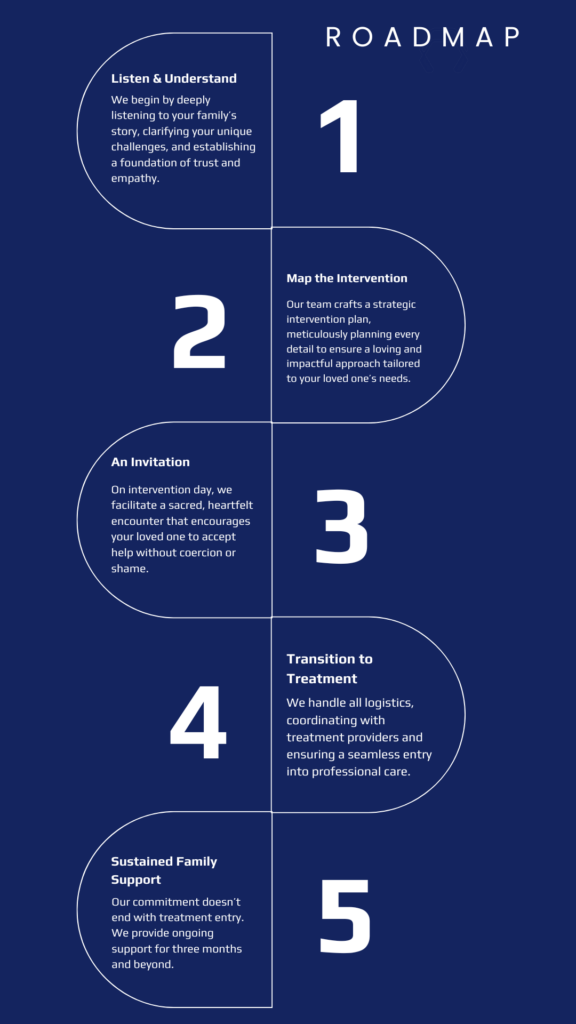
A successful intervention follows a structured process to maximize the chances of a positive outcome. Here’s how we guide families through each step:
We begin with a confidential discussion to understand your situation and provide insight into how an intervention can help.
Our team collaborates with family members to develop a strategic plan, including selecting participants, crafting
messages, and identifying appropriate treatment options.
We prepare all participants by guiding them on how to communicate effectively, set boundaries, and manage
emotional responses during the intervention.
Our professional interventionist facilitates the meeting, ensuring a calm, supportive, and goal-oriented discussion that motivates your loved one to accept help.
If your loved one agrees to treatment, we arrange seamless admission to a reputable facility, providing guidance every
step of the way.
After the intervention, we offer continued support and referrals for family counseling, support groups, and additional resources to promote healing for everyone involved.
Finding ongoing support is just as important as the first step into treatment. Alongside professional intervention, these trusted recovery programs provide safe spaces for individuals and families affected by addiction
Alcoholics Anonymous AA meetings in Florida are available in cities, towns, and coastal communities, offering peer support for individuals ready to begin or strengthen their recovery from alcohol use. Use the AA meeting search tool to find options close to your area.
Narcotics Anonymous NA meetings across Florida provide encouragement and accountability for people working toward freedom from drug addiction. Search by city or ZIP to locate groups in Miami, Orlando, Tampa, Jacksonville, and other areas.
Al-Anon Al-Anon groups in Florida welcome families and friends impacted by a loved one’s drinking, offering shared experiences and guidance. Use the official locator and select Florida to explore meetings statewide.
Navigating the road to recovery in Florida involves leveraging both statewide programs and local nonprofit resources. Families who understand how to connect with these services gain valuable support before, during, and after an intervention.
The Florida Department of Children and Families (DCF) oversees the Substance Abuse and Mental Health (SAMH) Program, the state’s primary public system for prevention, treatment, and recovery services.
This program funds community-based providers across all 67 counties, offering detoxification, residential treatment, outpatient counseling, and case management. Eligible individuals may receive services through Florida Medicaid or local grant-funded initiatives.
In addition, Florida Peer Services (administered by the Florida Certification Board) trains and certifies peer recovery specialists who support individuals and families throughout the recovery process.
For families coordinating interventions, knowing how to access these programs ensures that financial and logistical barriers don’t prevent timely care.
Below are some of the leading nonprofit organizations in Florida that provide addiction recovery support, education, and family resources:
Florida Alcohol and Drug Abuse Association (FADAA): A statewide advocacy and training organization that connects families with licensed treatment providers and peer-support programs.
Florida Harm Reduction Collective (FLHRC): Focuses on harm-reduction efforts such as overdose prevention, naloxone access, and safer-use education across Florida.
Hanley Foundation: Based in West Palm Beach, Hanley offers prevention education, family support programs, and scholarships for treatment.
Operation PAR, Inc.: Serving the Tampa Bay area for over 50 years, Operation PAR provides comprehensive treatment and family counseling for substance-use and co-occurring disorders.
Gateway Community Services: A nonprofit based in Jacksonville offering inpatient, outpatient, and adolescent treatment programs.
Each of these organizations plays a crucial role in expanding access to care and supporting families at every stage of recovery.
Taking action today can lead to life-changing results for your loved one. Our experienced interventionists in Florida are here to guide you through this challenging process with expertise, compassion, and unwavering support.
Fill out this simple form and we’ll call you right back.
Contact us now to speak with a professional interventionist in Florida. Let us guide you and your loved one towards a healthier future.

Yes, Crosswell serves families throughout Florida, including Miami-Dade, Orlando, Tampa Bay, Jacksonville, and Fort Lauderdale. Our interventionists coordinate directly with local treatment centers and ensure that each plan reflects Florida’s specific recovery landscape.
We assist with interventions for alcohol, opioids, fentanyl, methamphetamine, cocaine, prescription medications, and dual-diagnosis cases. Each intervention is personalized to the individual’s needs, with special attention to the leading substances in their region.
Absolutely. Many clients use services funded by the Florida DCF or Florida Medicaid. These programs support detox, residential treatment, and outpatient counseling. Our team can help you connect with certified local providers.
Crosswell’s Florida network allows us to begin within 24–72 hours. We manage communication with treatment centers, coordinate travel logistics, and guide families every step of the way.
Each region has unique challenges for instance, fentanyl-related overdoses in Miami differ from methamphetamine trends in Jacksonville. We analyze regional data and resources to ensure the plan fits the person’s environment and risk factors.