Professional Intervention Services in California to Help Your Loved One Begin Recovery
At Crosswell Interventions, we understand how difficult it is when a loved one is battling addiction or mental health issues. Our mission is to transform pain into purpose by offering expert, compassionate intervention services tailored to your family’s unique needs — right here in California.
A Structured, Supportive Conversation That Opens the Door to Recovery
WHAT IS AN INTERVENTION?
An intervention is a carefully planned and structured conversation where family members, friends, and an experienced interventionist come together to encourage an individual to seek treatment for substance abuse. This process aims to help the individual recognize the impact of their addiction and accept professional help in a supportive and non-judgmental setting.
Goals of an Intervention:

Break Through Denial: Address resistance to treatment and open the door to recovery.

Supportive Approach: Offer a loving, non-blaming environment that fosters acceptance.

Immediate Treatment Options: Present clear, actionable paths to treatment.

Firm Boundaries and Consequences:Set healthy boundaries to encourage a willingness to seek help.
Our Approach
We support your loved one with a carefully tailored intervention strategy and provide ongoing family support throughout the recovery journey.

Seeking the expertise of a seasoned interventionist can significantly increase the chances of a successful intervention. Here’s why our intervention services are exceptional in California:
1. Expert Knowledge and Experience
2. Customized Intervention Plans
We provide personalized intervention strategies tailored to your loved one’s unique needs in California, improving the chances of them accepting help and beginning their recovery journey.
3. Increased Success Rate
With a proven track record of successful interventions, our team improves the odds of your loved one entering treatment and beginning lasting recovery.
4. Support for Families
Our services extend beyond the individual in need of help. We empower families in California with the tools and strategies necessary to communicate effectively, set healthy boundaries, and offer ongoing support.
5. Seamless Transition to Treatment
From transportation to treatment center admission, we handle the logistics making sure your loved one gets to the right place with minimal stress.
California’s largest metropolitan regions face distinct and acute substance-use challenges. In the Los Angeles County metro area for example, public-health data show more than 1,482,000 residents live with a substance-use disorder. Among the major metro zones such as Los Angeles, San Francisco, San Diego and Sacramento, a combination of high population density, socioeconomic disparity and housing instability amplifies addiction risks. In Los Angeles County alone, there are roughly 146,087 alcohol-or-other-drugs (AOD) related emergency-department visits and 139,179 hospitalizations annually. These numbers reveal that the crisis is not only prevalent but also burdening medical and social-services systems; the county reports approximately $14.3 billion in hospital charges tied to AOD hospitalizations annually.
In the Bay Area and Inland Empire regions, shifting patterns such as increased stimulant use and prescription-drug misuse among younger adults (ages 18-35) are emerging. According to the California Department of Public Health (CDPH), use of prescription stimulants and heroin is more common among younger adults, while methamphetamine use is most frequent among adults ages 36–55. These regional snapshots underscore how addiction doesn’t follow a one-size-fits-all pattern: each metro area has its own drivers, trends and challenges.
For families in California seeking support, it’s essential to understand that where someone lives which county or metro zone influences what substances are most common, what resources are available, and what factors (such as housing, income, race/ethnicity) may affect access to care.
Substance Use Patterns and Most Common Addictions
Across the state, substance-use patterns reveal both expected trends and emerging concerns. A broad overview finds that about 9% of Californians aged 12 and older met the criteria for a substance-use disorder in the last year. Alcohol remains the most widely-used substance: half of Californians over age 12 reported using alcohol in the past month. Meanwhile about 20% reported using marijuana in the past year.
In Los Angeles County specifically, treatment-admissions data (fiscal year 2022-2023) show that methamphetamine led as the primary substance, accounting for approximately 30% of admissions, followed by alcohol at 27%. Heroin and prescription-drug misuse represented 16.2% and 14.9% of admissions respectively. Other areas such as rural counties and the Central Valley are seeing rising rates of prescription-opioid misuse and stimulant use.
When planning intervention or recovery support, families and professionals must pay attention to which substance is driving the crisis in that region, because it guides treatment modalities, aftercare, relapse-risk factors and coordination of support networks.
THE STEPS INVOLVED IN AN INTERVENTION
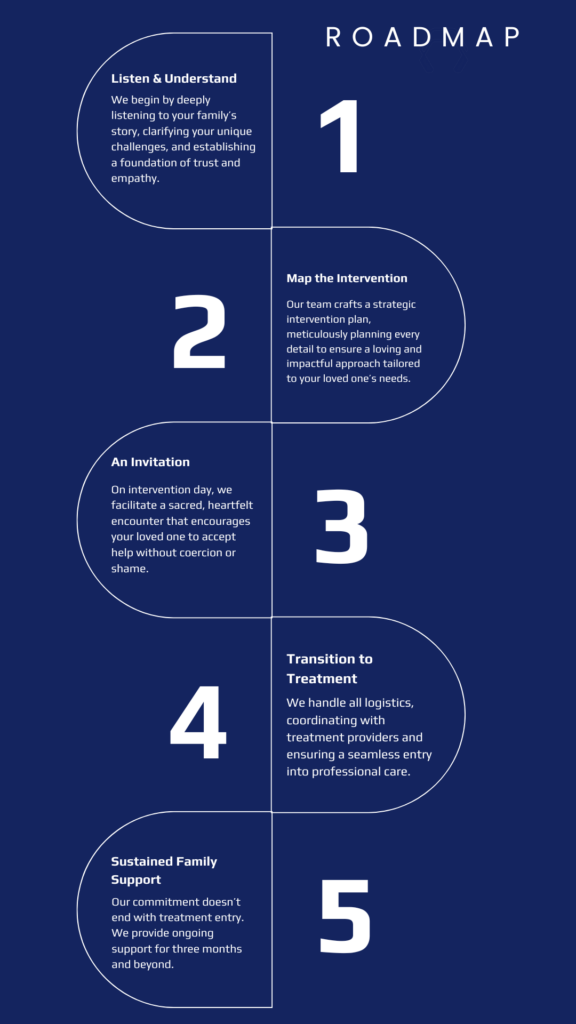
A successful intervention follows a structured process to maximize the chances of a positive outcome. Here’s how we guide families through each step:
STEP 1
Free Initial Consultation
We begin with a confidential discussion to understand your situation and provide insight into how an intervention can help.
STEP 2
Personalized Intervention Planning
Our team collaborates with family members to develop a strategic plan, including selecting participants, crafting
messages, and identifying appropriate treatment options.
STEP 3
Pre-Intervention Coaching
We prepare all participants by guiding them on how to communicate effectively, set boundaries, and manage
emotional responses during the intervention.
STEP 4
The Intervention
Our professional interventionist facilitates the meeting, ensuring a calm, supportive, and goal-oriented discussion that motivates your loved one to accept help.
STEP 5
Immediate Treatment Placement
If your loved one agrees to treatment, we arrange seamless admission to a reputable facility, providing guidance every
step of the way.
STEP 6
Ongoing Family Support
After the intervention, we offer continued support and referrals for family counseling, support groups, and additional resources to promote healing for everyone involved.
Every Step of the Intervention Matters
Recovery Meetings and Support in California
Finding ongoing support is just as important as the first step into treatment. Alongside professional intervention, these trusted recovery programs provide safe spaces for individuals and families affected by addiction
AA Meetings in California
Alcoholics Anonymous Meetings in California provide peer support for individuals seeking recovery from alcohol use. Whether you are in Los Angeles, San Francisco, or smaller towns, the meeting finder can help you locate groups nearby.
NA Meetings in California
Narcotics Anonymous Meetings throughout California offer safe and supportive environments for people working to overcome substance use. Use the search tool to find meetings by city or ZIP code.
Al-Anon Meetings in California
Al-Anon Groups in California provide comfort and guidance for families and friends affected by someone’s drinking. Use the meeting locator to explore options available statewide.

Recovery Meetings and Support in California
Navigating the recovery journey in California means more than connecting with a treatment provider it involves tapping into state-wide programs, local nonprofits and support networks that partner with families.
Drug Medi-Cal (DMC) Treatment Services
Administered by the California Department of Health Care Services (DHCS), this program provides medically necessary substance-use disorder (SUD) treatment to eligible individuals under Medi-Cal. Covered services may include outpatient, residential, and medication-assisted treatment.
Medi-Cal Peer Support Specialist Program
Run in partnership with the California Mental Health Services Authority (CalMHSA), this initiative certifies peer specialists who help individuals in recovery and often engage family members in the process.
Why Families Should Know
For loved ones coordinating an intervention, understanding how these public programs work and whether partial or full coverage applies can make professional care more accessible and affordable.
California Harm Reduction Initiative (CHRI)
Operated by the National Harm Reduction Coalition, CHRI partners with local agencies to promote harm-reduction strategies, syringe-service programs, and community-based resource access across the state.
California Consortium of Addiction Programs and Professionals (CCAPP)
The CCAPP is California’s largest professional organization for addiction-treatment providers, offering certification, education, and community outreach for both professionals and families seeking quality treatment options.
Los Angeles Centers for Alcohol & Drug Abuse (LA CADA)
LA CADA provides counseling, treatment referrals, and family-education workshops across Los Angeles County, helping loved ones better understand addiction and the recovery process.
Get Help from an Experienced Interventionist in California
Taking action today can lead to life-changing results for your loved one. Our experienced interventionists in California are here to guide you through this challenging process with expertise, compassion, and unwavering support.
Fill out this simple form and we’ll call you right back.
Now Serving Los Angeles, California
Start the Recovery Journey Today
Contact us now to speak with a professional interventionist in California. Let us guide you and your loved one towards a healthier future.

Frequently Asked Questions (FAQ)
Do you provide intervention services in Los Angeles County and surrounding metros?
Yes, Crosswell supports families across California, including Los Angeles County, Orange County, San Diego and the Inland Empire. Our expert team coordinates quickly, engages local treatment providers and manages logistics so you can focus on supporting your loved one.
What types of substance-use disorders do you handle in California?
We work with a broad range of substances alcohol, methamphetamine, heroin, prescription medications, fentanyl-laced stimulants and co-occurring disorders. Given California’s unique pattern (for example, methamphetamine currently being the primary driver in Los Angeles treatment admissions) we tailor each intervention to the specific person, their environment and support-network.
What state-level resources can families tap into before or after intervention?
In California, families can access state-funded SUD treatment through the Drug Medi-Cal program administered by DHCS. They can also reach out to accredited peer-specialists certified through CalMHSA. Nonprofits such as CHRI and CCAPP also provide education, support groups and harm-reduction resources.
How will you ensure the intervention is unique and suitable for the California regional context?
Our approach begins with a consultation specifically focused on your county or metro region (e.g., Los Angeles vs. rural Northern California). We analyse substance-use trends, local treatment-capacity, available bed space, legal-and-insurance contexts and then design the intervention accordingly.
How soon can the process begin once we decide to proceed?
Because we have established networks across California, we can often initiate planning within 24-72 hours of your decision. We’ll handle the referral coordination, admission process and family logistics so you can focus on healing and preparation.